
Civil engineering firms rarely “miss delivery” because they lack work. They miss delivery because the right leadership and technical capability was not in the seat early enough, or because a hire looked great on paper but could not operate inside your safety, quality, and client-facing reality.
That is the real value of a talent acquisition partner versus a transactional recruiter: aligning hiring decisions to the way you actually deliver projects.
This article breaks down a practical, delivery-first approach to hiring for U.S. civil engineering and infrastructure teams, including what to align, what to measure, and how to run the partnership so recruiting becomes a risk-control function, not a last-minute scramble.
“Align hiring with delivery” means hiring to project outcomes, not job descriptions
Most job descriptions describe responsibilities. Delivery needs something else: capability, timing, and decision-making under constraints.
When hiring is aligned with delivery, your recruiting process answers questions like:
- What must this person deliver in the first 90 and 180 days to protect schedule, margin, and client trust?
- What are the predictable failure modes for this role in your environment (safety lapses, weak subcontractor control, poor RFIs, change order leakage, late design coordination, utility conflicts)?
- What “great” looks like in your firm, with your PMO rhythms, QC culture, and client mix, not in a generic market.
A talent acquisition partner should treat those as the primary inputs, then design sourcing and assessment around them.
The core shift: from “time-to-fill” to “time-to-impact”
Time-to-fill is easy to track and easy to optimize in the wrong direction. If you only chase speed, you can accidentally select for availability rather than fit.
Time-to-impact is what delivery leaders care about. It connects hiring to:
- Ramp time (how fast a new hire can run a workstream independently)
- Rework and QC load
- Safety behaviors and field credibility
- Change management performance
- Client communication quality
A strong talent acquisition partner will still care about cycle time, but will govern the process so speed does not override evidence.
A delivery-first hiring framework (that works across PM, design, and leadership roles)
Below is a field-tested structure you can run with an internal TA team or an external specialist partner.
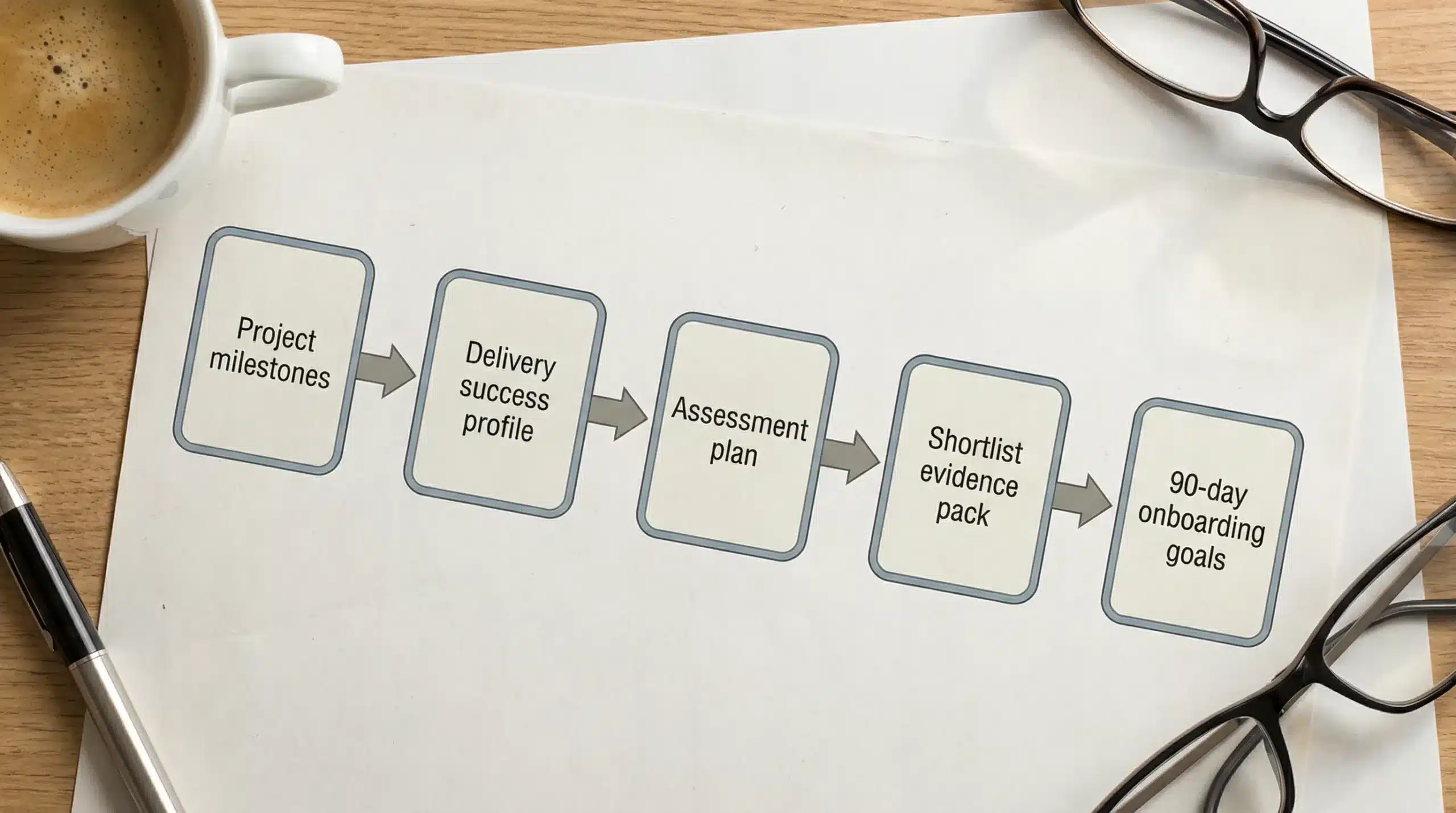
1) Start with a Delivery Success Profile (not a role description)
Before sourcing begins, document the few outcomes the hire must protect.
A good Delivery Success Profile is short and specific:
- Business context (project types, contract models, client standards, travel expectations)
- First 90 days outcomes (what must be stable, what must be improved)
- Technical scope (what they must be able to review, approve, stamp, or own)
- Leadership behaviors (how they run meetings, handle conflict, coach, and escalate)
- Non-negotiables (safety leadership, ethics, schedule discipline)
If you work with Alexander Executive Search, this is where tools like RoleDNA mapping and structured intake are intended to reduce ambiguity and stakeholder misalignment.
2) Translate delivery risk into interview and assessment evidence
Delivery alignment fails when interviews stay generic. “Tell me about yourself” does not reveal how someone will behave under a threatened milestone.
Instead, design evidence that maps to delivery risk.
| Delivery risk you need to control | What to test for in hiring | Practical evidence to collect |
|---|---|---|
| Schedule slip from poor planning or weak inter-discipline coordination | Planning rigor, dependency management, escalation judgment | Project case walkthrough: baseline plan, critical path changes, what they did when dates moved |
| Margin erosion from change order leakage or scope ambiguity | Commercial awareness, documentation habits, client negotiation | Example change log, RFI strategy, how they tied decisions to contract language |
| Field issues from weak constructability or utility conflicts | Field empathy, constructability lens, coordination skill | “Red flag” design review exercise: identify constructability risks and propose mitigation |
| Safety and quality incidents | Safety leadership, standards discipline, courage to stop work | Behavioral scenarios: stopping unsafe work, handling near miss reporting, quality hold points |
| Team burnout and turnover | Coaching, workload management, communication cadence | References focused on management style, conflict patterns, and retention impact |
A specialist partner can add rigor here with psychometric or behavioral assessments and structured competency-based evaluation, as long as the assessment is anchored to the Delivery Success Profile rather than used as a generic filter.
3) Build the “decision governance” that keeps hiring from stalling
In civil engineering and infrastructure, delays in hiring are often internal:
- Too many stakeholders
- Unclear decision rights
- Interview feedback that is opinion-based
- No deadline discipline
A talent acquisition partner should help you set simple governance:
- A single accountable hiring manager
- A small interview panel with defined focus areas
- A consistent scorecard tied to delivery outcomes
- Feedback windows (for example, same-day or next-day scorecard submission)
This is not bureaucracy. It is what prevents the common pattern where top candidates disengage because the process drifts.
4) Run sourcing like market mapping, not “post and pray”
Civil engineering hiring is frequently constrained by licensure, regional experience, client requirements, and credibility in the field. The strongest candidates are often passive.
That is why a delivery-aligned partner typically runs:
- Targeted identification of comparable project environments
- Outreach that speaks to delivery challenges (not just job perks)
- A qualification conversation that tests motivations and constraints early (relocation reality, travel tolerance, public-sector process familiarity, safety culture fit)
The outcome you want is a shortlist where each candidate is already “delivery plausible,” not merely available.
5) Close with evidence and momentum (without overselling)
Offer acceptance and early retention are part of delivery alignment.
Strong partners will help you:
- Present the role with clarity on success measures and support
- Address predictable concerns (project pipeline stability, decision authority, travel, hybrid expectations)
- Confirm references that speak to delivery behaviors, not just tenure
Alexander Executive Search positions its process around deeper verification and fit, and cites a 96% 12-month retention rate for placements. Retention is not a vanity metric here. In delivery terms, it is continuity of leadership, reduced rework, and fewer “reset” costs mid-project.
The partnership operating system: how to work with a talent acquisition partner day-to-day
The best recruiting outcomes are rarely accidental. They are governed.
Here is a simple operating rhythm many delivery-led firms use:
| Partnership element | What “good” looks like | Why it protects delivery |
|---|---|---|
| Intake kickoff | Delivery Success Profile agreed by all stakeholders | Prevents late-stage changes that kill the shortlist |
| Weekly pipeline review | Funnel health, risks, and decisions tracked | Keeps momentum, avoids candidate drop-off |
| Stage gates | Clear criteria to move from screen to shortlist to final | Reduces “vibes-based” interviewing |
| Candidate packs | Standardized evidence (competencies, references, assessments) | Faster decisions with less second-guessing |
| Close plan | Offer strategy, counter-offer risk, start-date plan | Converts final candidates without delays |
| Post-start check-ins | 30/60/90-day feedback loop | Catches misalignment before it becomes attrition |
This is where a partner becomes an extension of leadership, not just HR support.
A quick analogy: why “specialist partner” beats “generic vendor”
When something critical is at stake, most people do not pick the cheapest, fastest option. They pick the specialist who reduces risk.
A homeowner dealing with backups, old pipes, or persistent drainage issues typically wants licensed expertise, modern tools, and clear pricing because failure is expensive. That is why local specialists like TapTech’s plumbing and drain cleaning services emphasize dependable workmanship and upfront expectations.
Delivery-aligned hiring works the same way. If a role sits on your critical path, the recruiting approach should be designed to prevent failure, not merely to fill a seat.
What to ask a talent acquisition partner (to confirm they can align hiring with delivery)
Many firms claim they are consultative. Fewer can show they are delivery-minded.
Ask questions that reveal how they think:
- How do you translate our project risks into a candidate evaluation plan?
- What evidence do you deliver with each finalist (beyond a resume)?
- How do you handle stakeholder misalignment and changing requirements?
- What does your process do to predict retention, not just acceptance?
- How do you measure success, beyond time-to-fill?
The right partner will answer with process, artifacts, and examples of governance, not just enthusiasm.
The hidden financial logic: mis-hires are delivery losses, not just HR costs
In civil engineering, the cost of a poor hire is often underestimated because it appears in project KPIs, not HR budgets. You can see it in:
- Schedule slip and liquidated damages exposure
- Margin compression from rework and weak change control
- Safety incidents, quality failures, and reputational damage
- Burnout and secondary attrition (the “good people leave” effect)
If you want a structured way to estimate this risk, Alexander Executive Search offers a Bad Hire Cost Calculator on its site (use it to pressure-test the ROI of a more evidence-based search approach).
How Alexander Executive Search fits into a delivery-aligned hiring model
If you are hiring in U.S. civil engineering, infrastructure, engineering, or oil and gas, Alexander Executive Search is positioned as a specialist recruitment partner focused on reducing mis-hire risk and improving retention.
Based on the information provided, their approach includes:
- Sector-specific recruitment and executive search services
- RoleDNA mapping to define fit and success requirements
- Psychometric assessments to evaluate behavioral alignment
- Online candidate profiles to make evidence review easier for stakeholders
- A track record highlighted by a 96% retention rate
If your current hiring process produces late starts, weak shortlists, or avoidable turnover, the most practical next step is to treat hiring like delivery: define outcomes, map risks, and run a governed process with a partner built for your sector.

OUR BLOG
Explore our latest articles
CONTACT US
Change starts with a conversation
Complete the form to get started. We’ll get in touch to discuss our services and your options with you ASAP.