
Retention is not a “nice to have” in civil engineering leadership. When a project executive, PM, or regional leader exits early, the real cost shows up in missed deadlines, rework, client confidence, safety exposure, and the distraction of rehiring in a tight market.
So, do executive recruiting firms improve retention? They can, but only when their model is built to reduce mis-hire risk (not just fill a seat quickly) and when they prove it with clean, comparable retention data.
Below is what the data typically shows, what to ask for, and how to evaluate whether an executive recruiting firm will actually improve retention for your engineering organization.
What “retention” should mean in executive hiring
Many firms claim “great retention,” but retention is easy to inflate if it is not defined. In executive and senior technical hiring, you want time-bound, role-specific outcomes, not vague success stories.
Here are retention metrics that are decision-useful for engineering and infrastructure teams:
| Metric | What it measures | Why it matters in civil engineering leadership hires |
|---|---|---|
| 12-month retention | Stayed employed through 12 months | Captures early misalignment (scope, culture, leadership fit) |
| 24-month retention | Stayed through 24 months | Better proxy for long-term fit and delivery continuity |
| “Regretted” attrition | High-impact departures | Separates unavoidable churn from damaging losses |
| Time-to-productivity | Ramp speed into delivery | Predicts project risk, backlog health, and team stability |
| Performance trajectory | Expectations met by 6 to 12 months | Retention without performance is not a win |
If an executive recruiting firm cannot define retention precisely (window, cohort size, role types, and what counts as a “leaver”), the headline number is not decision-grade.
What retention data says about why senior hires leave
Most senior exits are not caused by a single factor like compensation. They are usually caused by avoidable mismatches that begin before the offer is signed, such as:
- Role ambiguity (unclear mandate, authority, success metrics)
- Cultural mismatch (decision pace, risk tolerance, stakeholder style)
- Mis-scoped expectations (what “hands-on” means, travel, client load, turnaround timeline)
- Unvalidated leadership behaviors (how the person performs under pressure, handles conflict, leads change)
The business case for improving retention is strong even before you get to project-specific impacts.
For example, the Center for American Progress has reported that replacement costs can range widely by role level, reaching well over 100% of salary for high-complexity positions. Executive and revenue-critical engineering roles also carry “hidden costs” that are harder to quantify (client churn risk, bid confidence, delivery delays).
This is the core point: retention is a downstream metric of hiring accuracy. If your process systematically improves accuracy, retention generally improves.
When executive recruiting firms improve retention (and when they do not)
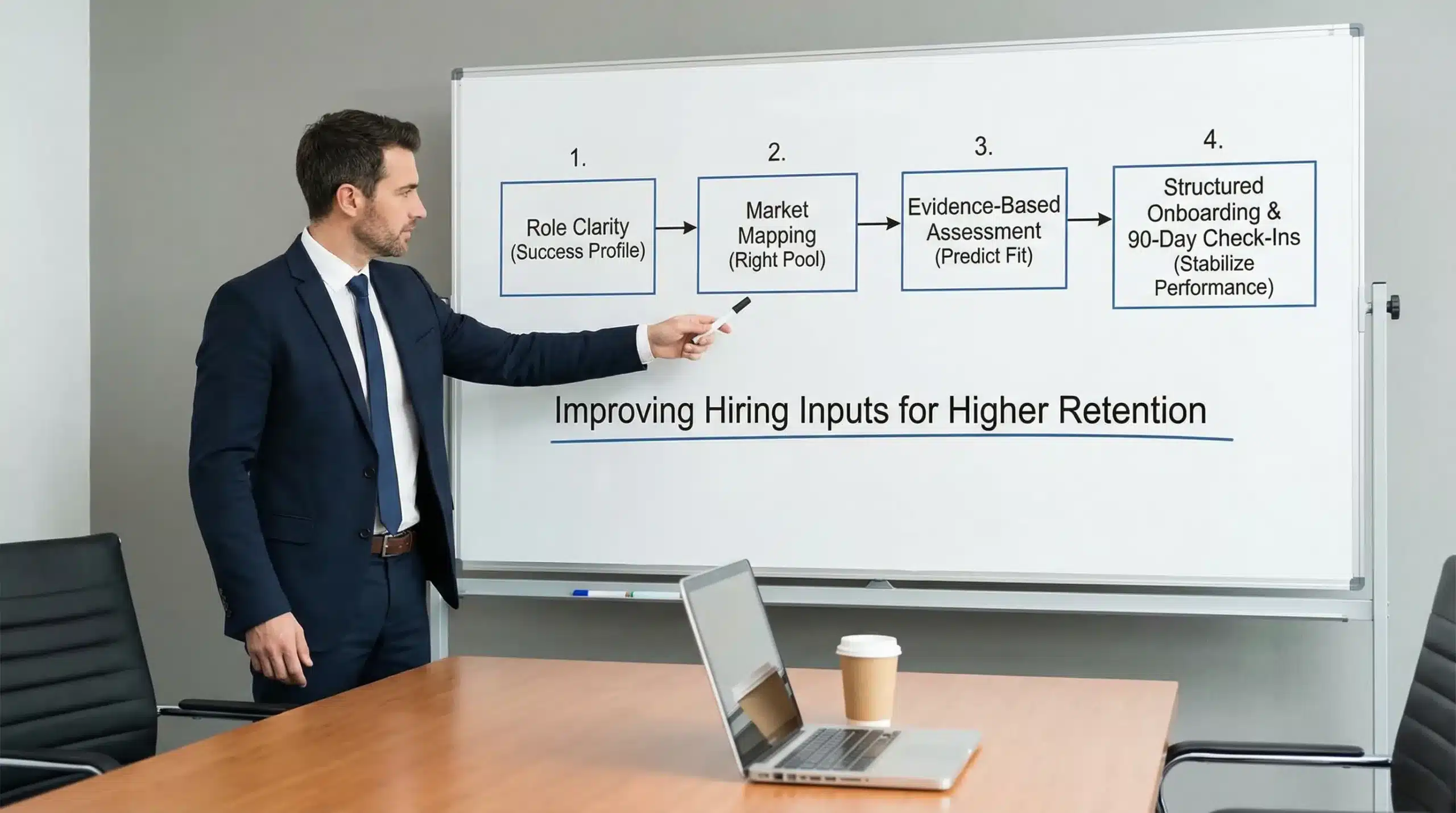
Retention does not improve simply because you paid a higher fee or used a more prestigious brand. Retention improves when the recruiting partner changes the inputs that usually cause early failure.
1) Incentives and governance (retained/exclusive vs contingency)
From a data perspective, the hiring model matters because it changes behavior:
- Contingency recruiting is often optimized for speed (first acceptable candidate wins).
- Retained or exclusive search can be optimized for rigor (role discovery, market mapping, deeper assessment), because the economics support more time per search.
This does not mean every retained firm delivers better retention. It means retained structures make it easier to run a process that predicts retention.
2) Better “role clarity” before sourcing starts
Executive retention often fails before sourcing, during intake.
High-performing executive recruiting firms typically insist on a structured intake that clarifies:
- The real mandate (stabilize delivery, grow a region, rebuild safety culture)
- Non-negotiables (licensure, client relationships, specific project delivery experience)
- Behavioral “deal breakers” (risk posture, stakeholder style, team leadership approach)
In AES terms, this is where RoleDNA mapping and role benchmarking reduce mismatch risk because the search is anchored to a measurable success profile, not a generic job description.
3) Evidence-based assessment (beyond the resume)
The strongest retention gains usually come from reducing false positives. For senior engineering and infrastructure roles, false positives are common when teams over-index on:
- Famous employers
- Years of experience instead of comparable scope
- Interview charisma
What improves retention is the opposite: structured evaluation that surfaces how a leader operates.
Assessment methods that tend to correlate with better retention include:
- Structured, competency-based interviews
- Verified references (with consistent questions tied to the success profile)
- Psychometric or behavioral assessments (used responsibly, as decision support)
This is also where a specialist partner can outperform generalist executive recruiting firms because they know what “good” looks like in your domain (project delivery tradeoffs, safety leadership, DOT and municipal stakeholder environments, utilization realities).
4) Post-acceptance risk control (the retention “handoff”)
Many early departures happen in the first 90 to 180 days, when expectations collide with reality.
Executive recruiting firms improve retention when they help clients:
- Pre-close the candidate on real constraints (travel, backlog, margins, politics)
- Align stakeholders on what success looks like in 30, 60, and 90 days
- Maintain structured post-placement check-ins (to spot mismatch early)
Retention is not just “hiring,” it is hiring plus integration.
What data to request from executive recruiting firms (a practical scorecard)
If you want to know whether executive recruiting firms improve retention in practice, ask for data that can be audited.
Ask for retention proof you can compare
Good answers include definitions, sample sizes, and time windows. Weak answers are testimonials only.
Request:
- 12-month and 24-month retention, defined clearly (what counts as “retained”)
- Cohort size (how many placements the metric is based on)
- Role mix (VPs, directors, senior PMs, division managers)
- Industry specificity (civil, infrastructure, water, transportation, etc.)
- Replacement policy details (what triggers it, how long it lasts)
Alexander Executive Search, for example, publishes retention outcomes and describes a data-driven methodology for executive recruitment, including candidate assessment artifacts and process transparency (see their overview of data-driven executive recruitment). Use that level of specificity as the bar when you compare firms.
Ask for leading indicators (they predict retention)
Retention is a lagging metric. Strong executive recruiting firms can also show leading indicators such as:
- Shortlist quality (how many candidates progress to final rounds)
- Offer acceptance rate
- Time-to-fill segmented by role type
- Candidate experience signals (drop-off reasons, counteroffer patterns)
These measures reveal whether the firm is consistently matching the right candidate to the right mandate, not just “filling.”
The retention ROI model (simple, but decision-ready)
If you are evaluating executive recruiting firms, a basic expected-value model helps you compare “cheaper” vs “more rigorous.”
You do not need perfect precision, you need reasonable ranges.
A simple way to frame it:
| Input | What to estimate | Example (illustrative, adjust to your situation) |
|---|---|---|
| Cost of failure | Direct and indirect cost if the hire fails | 50% to 200% of salary for high-impact roles (varies widely by context) |
| Failure probability | Chance the hire exits or underperforms inside 12 to 24 months | Your historical rate, by role |
| Risk reduction | How much a rigorous process reduces failure probability | Based on the firm’s measured outcomes and methodology |
If an executive recruiting firm can credibly reduce early failure probability, the ROI is often driven more by avoided disruption than by fee differences.
Where AI and analytics can strengthen retention outcomes
The most retention-focused recruiting teams are building a feedback loop: hire, measure outcomes, refine the success profile, repeat. In 2026, that is increasingly supported by automation and analytics.
Examples that can improve retention without adding bureaucracy:
- Turning past performance and tenure data into a success-profile baseline
- Automating structured reference capture and theme analysis
- Monitoring early warning signals (stakeholder misalignment, slow ramp indicators)
If your internal TA function needs help operationalizing this, an AI audit and custom AI solutions partner can be useful to connect ATS, HRIS, and interview data into dashboards and workflows your hiring managers will actually use.
What to look for if you are hiring civil engineering leaders in 2026
In civil engineering and infrastructure, retention risk is amplified by a few realities:
- Candidate supply remains tight in many regions and specialties
- Counteroffers are common for proven delivery leaders
- One mis-hire can destabilize multiple projects
So your evaluation of executive recruiting firms should focus on risk controls, not slogans.
A specialist partner should be able to show:
- How they define the role beyond the job description (success profile, RoleDNA-style mapping)
- How they validate both technical credibility and leadership behavior
- What their process produces as evidence (candidate packs, structured interview notes, verified references)
- How they reduce downside risk (for example, a documented replacement guarantee)
If you want to quantify your downside exposure before choosing a hiring model, AES also offers a practical bad hire cost calculator to frame the retention and failure risk in financial terms.
Frequently Asked Questions
Do executive recruiting firms improve retention more than internal recruiting? Often, yes for high-stakes roles, but not automatically. Retention improves when the process includes rigorous intake, deeper assessment, and post-acceptance risk control. Many internal teams do this well, and many external firms do not, so evaluate the methodology and the data.
What retention rate is “good” for executive hires? There is no universal benchmark because role scope, industry, and market conditions vary. Ask for 12-month and 24-month retention, segmented by role type, plus cohort size and definitions, so you can compare apples to apples.
How can I tell if a recruiting firm’s retention claims are credible? Ask for the definition (what counts as retained), the time window (12 or 24 months), cohort size, role mix, and how replacements are handled. Credible firms can explain how the metric is calculated and what actions drive it.
Is a replacement guarantee the same as better retention? No. A guarantee is a risk-transfer mechanism, not proof of quality. It matters, but the stronger signal is a process that prevents mis-hires, plus measured retention outcomes.
What matters more for retention, technical fit or cultural fit? For senior engineering roles, both are required. Technical fit gets someone in the door, cultural and leadership fit keeps them effective under pressure. Strong executive recruiting firms test both with structured evidence.
What should I ask in the kickoff call to reduce retention risk? Ask how success will be measured at 6 and 12 months, what behaviors predict success in your environment, who the key stakeholders are, and what would make a strong candidate leave in the first 90 days.
Want retention you can measure (not just hope for)?
If you are comparing executive recruiting firms for civil engineering, infrastructure, or engineering leadership roles, ask for evidence: defined retention metrics, an assessment-led methodology, and clear risk controls.
Alexander Executive Search specializes in these sectors and publishes methodology and retention outcomes. If you want to see what an evidence-based search process looks like in practice, you can request a conversation through the AES site and review their approach to data-driven executive recruitment.
OUR BLOG
Explore our latest articles
CONTACT US
Change starts with a conversation
Complete the form to get started. We’ll get in touch to discuss our services and your options with you ASAP.