
Hiring your first senior leader can feel like switching from a wrench set to heavy equipment. The stakes are higher, the talent pool is smaller, and the impact of a mis-hire often shows up fast in delivery, margin, and morale.
That’s where executive search comes in. Done well, it is a structured way to find and validate the right leadership talent, especially in specialized markets like civil engineering, infrastructure, and energy.
What executive search actually is (and what it is not)
Executive search is a proactive, research-driven recruitment method used to hire senior or business-critical roles. Unlike “post and pray” hiring, it focuses on:
- Identifying the target market (including candidates who are not applying anywhere)
- Approaching and engaging those candidates confidentially
- Assessing beyond the resume through structured evaluation and reference validation
- Managing stakeholder alignment so decisions are faster and less subjective
Executive search is not just “recruiting, but more expensive.” The difference is in the incentives and depth.
- Contingency recruiting is typically success-fee based and often optimized for speed and volume.
- Executive search is typically retained or exclusive and optimized for accuracy, risk control, and fit.
In civil engineering firms, that risk-control aspect matters because leadership hires influence project delivery, client confidence, safety culture, and retention across teams.
When you should use executive search (and when you should not)
Executive search makes the most sense when the role is hard to fill, hard to evaluate, or hard to replace.
Common “use search” situations
You are usually in executive search territory when:
- The role is senior (Director, VP, Principal, C-suite) or a discipline leader with revenue or delivery accountability
- The market is tight and most viable candidates are passive (not actively applying)
- You need confidentiality (succession planning, replacing an underperformer, launching a new office)
- The cost of a wrong hire is high (project risk, client churn, safety exposure, missed backlog)
When executive search may be overkill
Executive search can be the wrong tool when:
- You have a strong inbound pipeline and the role is not scarce
- You mainly need extra hands to screen applicants for a role with clear, high-volume supply
- The business cannot commit to a consistent interview process and timely feedback
A simple decision lens is: if you cannot afford a mis-hire and you cannot easily “try again,” executive search is usually justified.
Executive search vs other hiring options (quick comparison)
| Hiring approach | Best for | Strengths | Common tradeoffs |
|---|---|---|---|
| Job ads + inbound | Roles with strong applicant flow | Low cost, fast start | Passive talent missed, noisy pipeline |
| Internal referrals | Most levels | Trust, speed, cultural signal | Network bias, limited reach |
| Contingency recruiting | Mid-level roles with urgency | Speed, market activity | Incentives can favor speed over depth |
| Executive search | Senior, scarce, confidential, high-risk roles | Passive talent access, assessment rigor, process governance | Requires stronger alignment and commitment |
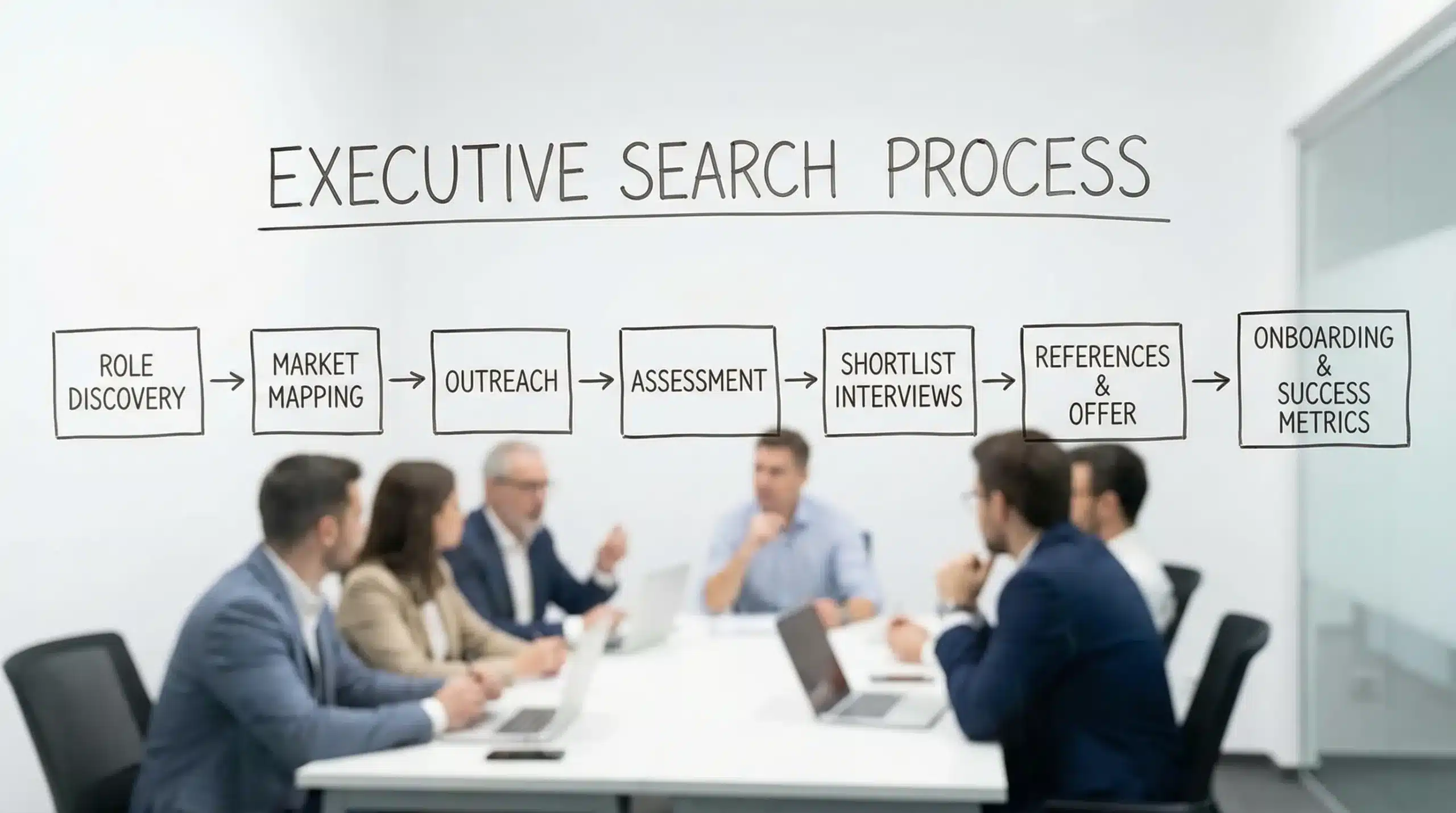
The executive search process, step by step (what to expect)
A high-quality search is more like a project than a transaction. While firms vary, the stages below are typical.
1) Role discovery and alignment
This is the most important stage and the one first-time hiring managers often rush.
A good search partner will push you past a generic job description and into a measurable success profile, for example:
- What must this leader deliver in the first 6 to 12 months?
- What does “good” look like in this specific firm (not in theory)?
- Which stakeholders will judge success, and what do they disagree on today?
If you operate in specialized engineering markets, this is also where a partner may use tools like competency mapping and behavioral benchmarking to reduce ambiguity.
2) Market mapping and target list
Search teams build a map of where the right candidates likely sit:
- Competitor and adjacent firms
- Owner-side organizations, consultancies, contractors, and client organizations (depending on the role)
- Geography options (including relocation and remote-hybrid realities)
This is also where compensation reality often gets clarified. A good search partner will tell you early if your target profile and budget are misaligned.
3) Outreach and candidate engagement
Senior candidates rarely respond to generic messages. Effective outreach includes:
- A credible narrative about the business problem (not just the title)
- Why this role matters now
- Why the firm is a compelling platform for the candidate
In 2026, candidates also do fast due diligence online. If your leadership team’s visibility is weak, it can slow response rates. For executives who want to strengthen their credibility on LinkedIn without turning it into a second job, services like Windmill Growth can be relevant.
4) Screening and evidence gathering
High-quality executive search should feel structured, not conversational. Expect:
- Role-based screening tied to outcomes
- Structured interviews
- Work history validation (scope, budgets, delivery complexity)
- Behavioral and leadership evaluation (often where mis-hires originate)
5) Shortlist and structured client interviews
A strong shortlist is usually small. What matters is not the number of resumes, but the quality of evidence.
Your job as the hiring manager is to keep interviews consistent:
- Same core questions for each candidate
- A shared scorecard agreed before interviews start
- Fast debriefs to avoid “recency bias” and personality-driven decisions
6) References, closing, and onboarding support
Final-stage failures often happen here, not earlier.
Expect a good search partner to help with:
- Reference strategy (who to call, what to validate)
- Offer positioning and risk management
- Resignation risk controls and counteroffer planning
- Early onboarding milestones tied to the success profile
Your “first-time hiring manager” kickoff checklist (steal this)
Before you engage executive search, get these decisions made. This will save weeks.
- Business problem statement: What pain does this role solve (delivery, growth, client retention, margin, safety)?
- Success outcomes: 3 to 5 measurable outcomes for the first 6 to 12 months.
- Non-negotiables: Licensure requirements, market expertise, client type, delivery scope.
- Tradeoffs you accept: Relocation vs local, client network vs operational depth, big-firm pedigree vs entrepreneurial fit.
- Interview panel and decision owner: Who decides, and how ties are broken.
- Timeline and availability: Interview blocks on calendars now, not “when we get resumes.”
How to evaluate candidates without defaulting to “gut feel”
First-time hiring managers often over-rotate on pedigree because it feels safe. But leadership hires fail more often from fit, priorities, and operating style than from raw technical capability.
A more defensible approach is to evaluate in layers:
Layer 1: Delivery evidence
Look for specifics:
- What did they deliver, by when, and with what constraints?
- What changed because they were there (schedule recovery, margin improvement, reduced rework, talent stability)?
Layer 2: Leadership behaviors
Probe for repeatable patterns:
- How they handle conflict with clients and internal stakeholders
- How they develop PMs and discipline leads
- How they make decisions under uncertainty
Layer 3: Context fit
A leader can be excellent and still be wrong for your environment. Validate:
- Pace (high-growth vs steady-state)
- Operating model (matrix vs tight hierarchy)
- Risk tolerance (especially in infrastructure and regulated work)
If you want a deeper dive on evaluation rigor in engineering leadership hiring, Alexander Executive Search publishes practical guidance on choosing a partner and assessing methodology, including this resource: How to Choose an Executive Search Agency for Engineering.
Timelines, communication rhythm, and what “good” looks like
While every market differs, executive search is rarely instantaneous because you are persuading high-performing, employed people to consider change.
To keep momentum without sacrificing quality, set a clear operating rhythm:
- Weekly progress update (market feedback, outreach volume, emerging risks)
- Agreed turnaround times for client feedback after interviews
- A single point of contact on your side to prevent mixed messages
If a search drags, it is usually due to one of these issues:
- The role is not defined in measurable outcomes
- Stakeholders disagree and keep changing the target
- Interview scheduling is slow
- Compensation and role scope do not match the market
What to ask an executive search firm as a first-timer
You do not need to be a procurement expert to vet a search partner. You need to validate whether they can reduce risk in your specific context.
Ask for:
- A clear explanation of how they define success for the role (not just “we’ll find great people”)
- How they source passive candidates (market mapping approach)
- What their assessment process looks like beyond resumes
- How they manage stakeholder alignment and prevent process drift
- What deliverables you will receive (shortlist format, evidence, references)
If you want a ready-made list of due diligence questions, this companion guide is helpful: Executive Search Companies: Questions to Ask Before You Sign.
Common mistakes first-time hiring managers make (and how to avoid them)
Mistake 1: Hiring a title instead of solving the business problem
If you cannot describe the role in outcomes, you will interview on vibes. Start with delivery outcomes and design the role around them.
Mistake 2: Confusing “technical excellence” with “leadership effectiveness”
In civil engineering, technical credibility is necessary. It is not sufficient. Leadership roles require operating cadence, stakeholder management, and talent development.
Mistake 3: Letting the process get subjective
Unstructured interviews produce inconsistent data. Use a scorecard and consistent questions, then debrief quickly.
Mistake 4: Underestimating the cost of a mis-hire
Even without a precise formula, the practical costs stack up fast: lost time, team disruption, project delays, client confidence, and running the search again.
If you want to quantify downside in your context, AES offers a tool specifically for this: the Bad Hire Calculator.
A practical next step if you are about to run your first search
If you are hiring a senior leader in civil engineering or infrastructure for the first time, aim for clarity before speed:
- Define the success profile in measurable outcomes
- Align stakeholders and decision rules
- Choose a search approach that matches risk and scarcity
- Use structured assessment so the final decision is evidence-led
Alexander Executive Search focuses on civil engineering and adjacent sectors, using assessment-led executive search designed to improve fit and retention. If you want to see what a structured, risk-managed hiring process looks like for your role, start here: The recruitment process for engineering leaders, step by step.
OUR BLOG
Explore our latest articles
CONTACT US
Change starts with a conversation
Complete the form to get started. We’ll get in touch to discuss our services and your options with you ASAP.