
As any engineering executive search firm will tell you, executive hires in engineering rarely fail because the person “can’t do the technical work.” They fail because the leader can’t scale delivery, can’t win internal trust, or can’t operate inside your risk, quality, and client constraints.
That’s why choosing the right executive search agency is less about who has the biggest database, and more about who can accurately predict on-the-job success for your specific environment.
Below is a practical, engineering-specific framework you can use to evaluate agencies, compare proposals, and avoid expensive mis-hires.
How to choose an executive search firm for engineering: start with the realities of leadership hiring
Engineering leadership is a different hiring market than general corporate executive recruitment. Your search partner should understand that:
- Stakes are contract-level, safety-level, and reputation-level, not just “team performance.”
- Candidate pools are often passive, especially in civil infrastructure and specialized disciplines.
- Leadership success depends on behaviors (decision-making under pressure, stakeholder management, commercial judgment), not only years of design or construction experience.
- Confidentiality matters, because many candidates are still employed by competitors or client-side organizations.
If an agency speaks only about job boards, speed, or “we have candidates ready,” treat that as a warning sign for senior engineering roles.
Step 1: Get crystal clear on what “success” means in the role
Before you compare agencies, pressure-test your own role definition. A strong agency will push you to define outcomes and operating context, not just responsibilities.
Look for partners who help you document:
- The business problem the hire must solve (growth, turnaround, margin protection, succession, delivery stabilization)
- The leadership behaviors required to succeed inside your culture
- The stakeholders the hire must influence (DOTs, municipalities, utilities, boards, JV partners, prime contractors)
- The non-negotiables (licensure, market sector depth, client relationships, geographic requirements)
This is also where structured role mapping adds value. For example, Alexander Executive Search references RoleDNA™ mapping as part of its process, which is designed to clarify the “fit” requirements early, before sourcing begins.
Step 2: Validate engineering specialization (not just “industry experience”)
Many firms claim they “work in engineering.” Fewer can demonstrate repeatable success in your specific lane.
When evaluating specialization, ask for evidence in areas that matter most to you:
- Similar role scope (P&L leadership, regional operations, PMO oversight, practice lead, C-suite)
- Similar project environment (DOT, water/wastewater, aviation, heavy civil, energy, EPC)
- Similar firm model (employee-owned, PE-backed, multi-office matrix, design-build)
A specialist should be able to discuss market compensation ranges, relocation realities, and candidate motivations in your niche without guessing.
Step 3: Compare sourcing strategy (market mapping beats “posting and hoping”)
For executive engineering roles, the best candidates are commonly not applying anywhere.
A credible executive search agency should be able to explain, in plain language, how they:
- Build a target list of relevant firms and adjacent talent pools
- Identify passive leaders (not just active applicants)
- Approach candidates confidentially and professionally
- Manage off-limits and conflict of interest policies
If the plan is primarily job ads and inbound resumes, you are likely buying volume, not precision.
Step 4: Assess how they evaluate candidates (beyond the resume)
The agency’s assessment method is where quality is won or lost. Engineering executive hires must be evaluated for leadership behaviors, decision-making patterns, and commercial judgment, not just project history.
At minimum, ask how the agency validates:
- Leadership capability (how they lead teams, handle conflict, manage performance)
- Delivery discipline (risk management, QA/QC mindset, schedule rigor)
- Client trust and business development behaviors
- Cultural alignment and stakeholder style
Many high-performing search partners also use structured assessments. AES, for instance, describes a data-driven model that includes psychometric assessments and benchmarking candidates against role requirements, along with an online profile format for reviewing shortlists (details here: data-driven executive recruitment).
A quick “depth check” you can use
Ask the agency to walk you through their last three placements and explain:
- What the hiring manager originally wanted
- What they discovered during intake changed the search
- Why the selected candidate beat the runner-up
- What performance looked like 6 to 12 months later
Shallow agencies stay in “years of experience” and “great communication.” Strong agencies can describe decision points and evidence.
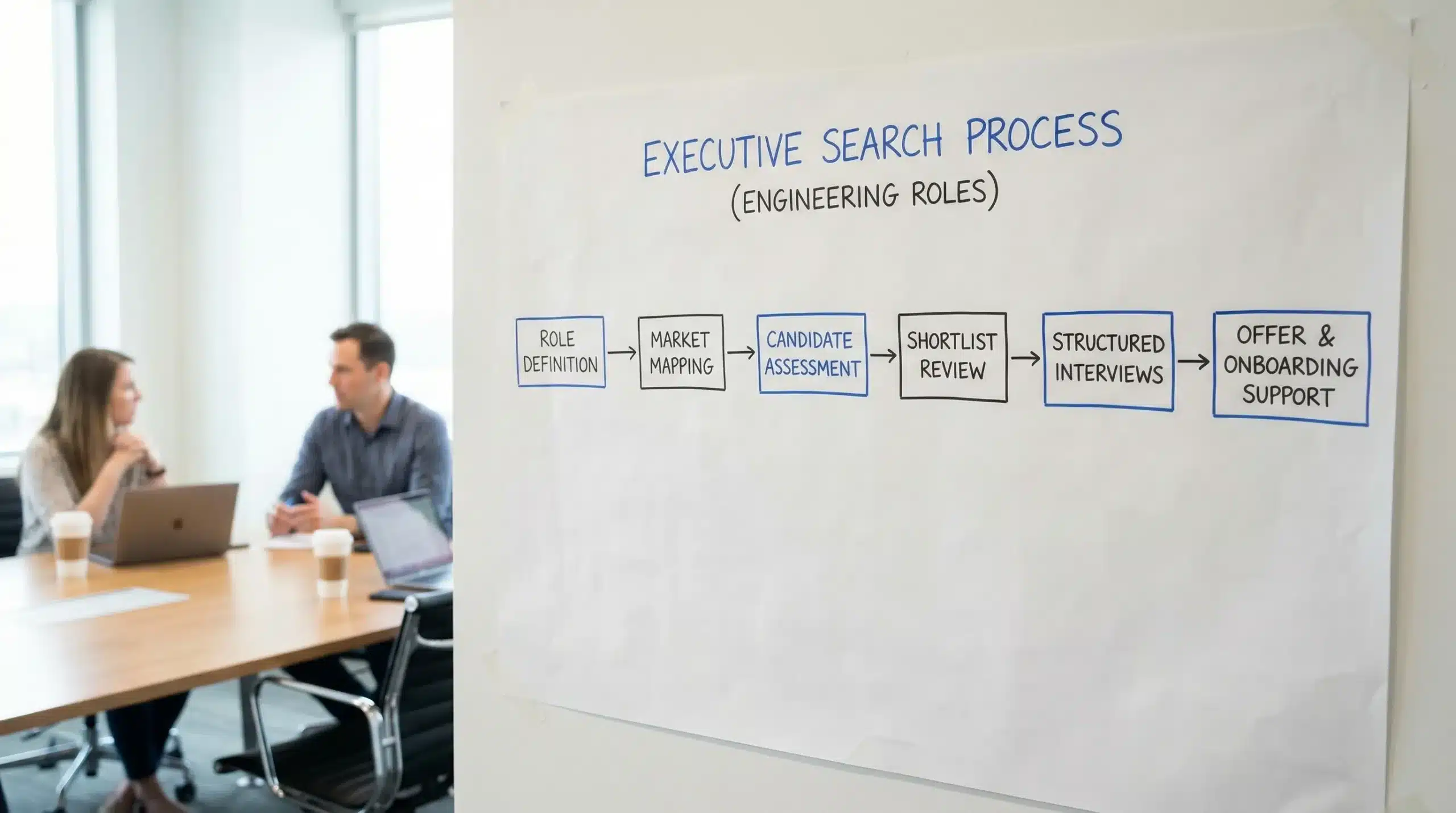
Step 5: Demand transparency in process, reporting, and shortlist quality
Engineering leadership searches involve multiple stakeholders. If your agency cannot keep the process aligned, the search will drift.
Look for:
- A documented timeline from kickoff to shortlist to offer
- Clear communication cadence (weekly updates, not “when we have news”)
- Candidate submission packs that make comparison easy
- A structured interview plan that reduces bias and inconsistency
Some firms provide centralized digital shortlists and candidate profiles to help speed stakeholder review and reduce email chaos. If your team has ever lost a great candidate because internal feedback took too long, this matters.
Step 6: Evaluate risk management (guarantees, replacement terms, and accountability)
A serious executive search agency should stand behind the quality of its work.
Review these items carefully in the contract:
- Replacement guarantee terms (duration, conditions, and what is covered)
- What happens if the role changes mid-search
- Candidate ownership terms and time limits
- Off-limits (who the agency is prohibited from recruiting, and for how long)
AES publicly references a 12-month replacement guarantee (extended to two years for senior executive roles) for its engineering recruitment, which is one example of how an agency can share risk with the client (see: engineering recruitment guarantee).
Step 7: Compare fee model alignment (retained vs contingency)
Fee model influences behavior.
- Contingency models typically reward speed and volume because the recruiter is only paid if they place someone (and they may be working multiple roles for multiple clients at once).
- Retained executive search typically supports deeper intake, dedicated research, and higher-touch assessment because the recruiter is engaged exclusively for the search.
There are good and bad operators in both models, but for critical engineering leadership roles, you want incentives that support accuracy and long-term fit.
If you want a deeper read on how misaligned incentives can impact shortlist quality, this AES perspective is useful: The real reason your recruiter is hurting your business.
Step 8: Use a simple scorecard to compare each executive search firm side by side
When multiple stakeholders are involved, a scorecard prevents “who did we like most on the call?” decision-making.
| Evaluation area | What “good” looks like | What to watch for |
|---|---|---|
| Engineering specialization | Proven placements in similar roles and sectors | Vague claims, no comparable examples |
| Role definition | Helps you define outcomes, behaviors, and constraints | Rushes to post the job |
| Sourcing approach | Market mapping and proactive outreach | Mostly inbound applicants |
| Assessment rigor | Structured interviews, references, and (where appropriate) assessments | Resume-led screening only |
| Transparency | Weekly reporting, clear pipeline data | “Trust us” updates |
| Risk sharing | Clear guarantee and accountability | No meaningful warranty |
| Process discipline | Timeline, stakeholder alignment, interview structure | Process feels improvised |
The questions to ask on an executive search agency call
Use these questions to quickly separate senior operators from generalist recruiters:
- “How will you define role success beyond the job description?”
- “What does your market mapping look like for our specific niche?”
- “How do you assess leadership behaviors that impact delivery and retention?”
- “What is your typical shortlist size, and what evidence is included per candidate?”
- “How do you manage confidentiality and off-limits in our market?”
- “What does your guarantee cover, and what are the conditions?”
- “How do you support interview structure and stakeholder alignment?”
If an agency cannot answer these with specifics, you are buying hope, not process.
Common red flags when hiring an executive search agency for engineering
These signs often correlate with poor outcomes:
- The agency proposes candidates before doing a deep intake.
- They focus on “who’s available now,” not who will succeed in your environment.
- They cannot explain how they evaluate leadership behaviors.
- They are vague about off-limits, conflicts, or confidentiality.
- They overpromise timelines without discussing market realities.
How to vet an executive search agency in a 30-minute call
You can learn a lot about an agency in half an hour if you time-box the conversation:
- Minutes 0–10: the job behind the job. Ask how they build the role definition and what they deliver after intake. Listen for multi-stakeholder intake, outcomes for the first 6 and 12 months, and behavioral expectations. Ask, “What are the top three reasons this role fails in firms like ours?” A specialist answers with delivery context; a generalist answers with HR language.
- Minutes 10–20: sourcing reach. Ask what the sourcing plan looks like in weeks one and two, how they handle off-limits and conflicts, and how many people they typically speak to in order to produce a shortlist of three to five. You want evidence of a real market map and funnel, not database browsing.
- Minutes 20–30: evidence and risk controls. Ask what evidence you receive for each finalist besides a resume, and how they reduce the risk of a bad hire beyond interviews. “We’re good judges of character” means you are buying gut feel.
Questions to ask before you sign
The contract stage is where you have the most leverage. Before you commit, get clear answers to these:
- Off-limits: Which companies are off-limits, and for how long? Will the firm recruit from your clients, partners or key subcontractors? In concentrated regional markets, conflicts can quietly remove the best candidates.
- Candidate ownership: Can candidates who were introduced but not hired be approached later, and on what terms?
- Fees and milestones: Is the search retained, exclusive or contingency? What triggers each invoice, and are milestones meaningful (for example, intake and market mapping completed)? Are advertising, travel, assessments or background checks billed separately? What happens if you pause or cancel?
- Data handling: How are candidate records, compensation details, reference notes and assessment results stored, who can access them and when are they deleted?
For a fuller contract review, see our executive staffing agency checklist for contracts, fees and guarantees.
Build a simple hiring risk register
Procurement teams use risk registers to choose vendors, and hiring teams can do the same. List what could go wrong in this specific role, then ask each agency how its process reduces each risk.
| Hiring risk | Where it shows up | What mitigates it | What to ask the agency |
|---|---|---|---|
| Wrong technical scope | Late interviews, project delivery issues | Clear success profile, technical validation | “How do you verify technical credibility beyond the resume?” |
| Culture misfit | 30 to 180 days | Behavioral assessment, structured evidence | “How do you define and test culture fit without bias?” |
| Stakeholder disagreement | Interview loops, no decision | Kickoff alignment, stage gates | “Who must sign off on success criteria before sourcing?” |
| Confidentiality leak | Market rumors, retention issues | Controlled outreach, tight communication | “How do you run confidential searches and document contact?” |
| Offer fallout | Counteroffers, slow approvals | Pre-closing, fast governance | “When do you test motivation and compensation expectations?” |
| Early attrition | 3 to 12 months | Onboarding checkpoints, guarantee | “What post-placement support is included, and for how long?” |
What a decision-ready shortlist should include
A resume plus “references later” is rarely enough for a delivery-critical role. Ask what you will receive for each finalist:
| Shortlist component | What it tells you | Why it improves the hire |
|---|---|---|
| Success profile or role scorecard | What “good” looks like | Keeps interviews and feedback consistent |
| Verified career summary | What they actually did | Reduces embellishment and title inflation |
| Project evidence | Relevance to your work | Filters out surface-level similarity |
| Structured interview notes | How they think and lead | Makes finalists comparable |
| Behavioral insights | Work style and risk tendencies | Reduces mis-hires driven by charisma |
| References, timed appropriately | Pattern confirmation | Validates strengths and flags recurring issues |
| Compensation and availability | Whether the offer will land | Prevents late-stage surprises |
When shortlists fail, it is rarely for lack of candidates. The usual causes are a role that is over-specified or not agreed internally, a market reality check on pay, location or scope that comes too late, interview panels that ask different questions and score differently, and slow feedback that pushes senior candidates away.
Evidence checks that prevent leadership mis-hires
A good agency helps you collect and compare evidence on the things that predict performance in your environment:
- Delivery under similar constraints: contract types (design-bid-build, design-build, CMAR), client profile (DOT, municipal, private developer), backlog owned, span of control and schedule recovery examples.
- Leadership operating rhythm: how they run project reviews, escalate risks, coach project managers and make decisions with imperfect information.
- Safety and quality behaviors: how they respond to near-misses and handle schedule pressure when safety is at stake.
- Stakeholder management under pressure: for example, “Tell us about a time you had to disappoint a major client to protect delivery integrity.”
- Commercial judgment: utilization, risk pricing, scope control and write-down prevention.
- Motivation and staying power: whether they want to build, stabilize or transform, and whether that matches what you need.
- References that confirm patterns: behavior under stress, conflict handling and how they develop the leaders beneath them.
Average vs. best-in-class executive search agencies
| Dimension | Average agency | Best-in-class agency |
|---|---|---|
| Role intake | Job description review | Outcome-based success profile tied to delivery risk |
| Talent access | Applicants plus a warm network | Market map plus consistent passive outreach |
| Candidate evaluation | Unstructured interviews | Comparable evidence across finalists |
| Shortlist | Larger list to “show activity” | Small, decision-ready shortlist with tradeoffs disclosed |
| Process | Reactive and availability-driven | Governed cadence with clear deliverables and decision rights |
| Transparency | Limited, mostly verbal updates | Written evidence, verified claims, consistent scoring |
| Incentives | Paid only on placement; speed rewarded | Aligned to quality and retention (often retained) |
| Risk controls | Short guarantee, limited coverage | Clear replacement guarantee and onboarding support |
Engineering roles a specialist agency can fill quickly
Not every engineering hire needs a long search. Roles with clear success patterns and mappable talent pools tend to move fastest with a specialist, provided the brief is clear:
- Project managers (civil, transportation, water, land development)
- Discipline leads and technical managers (structural, geotechnical, drainage, roadway)
- Resident engineers and construction engineering inspection (CEI) leads
- Estimators, preconstruction leads and pursuit-focused engineers
- CAD/BIM managers and design technology leads
- Safety managers and EHS leaders
- Operations managers for field-led delivery
- Business development directors and client account leaders
C-suite, regional leadership and P&L roles usually take longer, because the brief is broader and the right people are fewer and harder to move.
Frequently Asked Questions
Do I need an executive search agency for engineering, or can my internal team handle it? Many internal teams can run strong processes, especially with time and market reach. Executive search is most valuable when the candidate pool is passive, the role is confidential, or the cost of a mis-hire is unusually high.
What’s the difference between an executive recruiter and an executive search agency? “Recruiter” can refer to many models (contingency, in-house, contract). An executive search agency typically runs a structured search, including market mapping, proactive outreach, and deeper assessment for senior roles.
How long should an engineering executive search take? Timelines vary by role seniority, specialization, and location. A credible agency should provide a realistic timeline and weekly visibility into pipeline progress, rather than a fixed promise with no data behind it.
What should be included in a high-quality shortlist? Beyond resumes, look for evidence like structured interview notes, competency validation, reference insights, and clear rationale linking candidate strengths to the role’s success profile.
How do I estimate the financial impact of a bad executive hire? You can model direct costs (search, onboarding, compensation) and indirect costs (lost productivity, rework, delivery risk, morale). AES provides a practical tool here: Bad Hire Calculator.
Talk to a specialist executive search partner for engineering
If you’re hiring a senior engineering leader and want a process built for long-term retention, not just a fast placement, Alexander Executive Search outlines a data-driven approach for civil engineering and infrastructure firms, including structured candidate assessment, transparent shortlists, and a 12-month replacement guarantee (extended to two years for senior executive roles).
You can review their methodology here: How Alexander Executive Search removes the guesswork from recruitment. To see how a search with us works in practice, read For Clients, or our executive search for mid-sized engineering firms. If you want to discuss an upcoming role confidentially, start with an initial conversation via Alexander Executive Search.
OUR BLOG
Explore our latest articles
CONTACT US
Change starts with a conversation
Complete the form to get started. We’ll get in touch to discuss our services and your options with you ASAP.