
Engineering leaders usually turn to agency work for one reason: delivery pressure. A project award lands, a schedule slips, a key PM resigns, or a client demands 60 percent design next month, and the fastest lever to pull is extra capacity.
Used well, engineering agency work can protect revenue, keep contracts on track, and buy time to make better long-term hiring decisions. Used poorly, it can inflate costs, dilute accountability, and create compliance risk.
This guide breaks down the real pros and cons, the situations where agency talent delivers outsized ROI, and the decision rules civil engineering and infrastructure firms can use to choose the right model.
What “engineering agency work” actually means (in civil engineering)
In the U.S. engineering market, “agency work” typically shows up in three practical forms:
- Staff augmentation via staffing agency: the engineer is employed by the agency (often W-2 through the firm), billed hourly, and embedded in your team.
- Independent contractor (1099) arrangements: individual consultants engaged directly (this can create worker classification risk if misused).
- Subconsultant or specialty firm support: a separate company delivers defined scope (survey, geotech, traffic, inspection, BIM/CAD production), often as a subcontract.
The right choice depends less on title and more on two things: how you manage outcomes (hours vs deliverables) and how much delivery risk the role carries.
The biggest pros of engineering agency work
Agency work is not just “renting a resume.” When it pays off, it does so through speed, optionality, and risk control.
1) Speed to capacity when schedules matter
When a project schedule is the constraint, adding vetted capacity quickly can be cheaper than the downstream cost of delay (liquidated damages, client confidence loss, overtime burn, and rework).
In practice, agency capacity is often the fastest way to staff:
- Construction inspection and CEI surges
- Design production spikes (CAD/BIM, roadway drainage, structural detailing)
- Short-notice backfills for maternity leave, medical leave, or resignations
2) Flexibility without long-term overhead
Direct hires are a fixed commitment. Agency talent is a variable lever.
This is valuable when:
- Funding is uncertain
- Work is seasonal
- You are expanding into a new geography and want proof before building a permanent bench
3) Access to niche experience for narrow windows
Some skills are needed intensely, but briefly (for example, a specialty modeling workflow, a specific client standard, or a permit-heavy phase). Agency work can solve the “10-week expert” problem.
4) “Try before you buy” (when you structure it correctly)
Some firms use agency engagements as a de-risking step before converting to a permanent hire.
This can work, but only if you treat the engagement like an evaluation period with clear success criteria, not a vague time-based trial.
5) Reduced recruiting burden on internal leaders
Even when you have internal HR, sourcing and screening for hard-to-find technical talent consumes senior billable time. Agency work can move the sourcing load outward.
For permanent critical hires, this is where a specialist partner with rigorous assessment becomes more important than “more resumes.” (More on that below.)
The real cons and hidden costs (what leaders underestimate)
Agency work often looks expensive on paper due to hourly bill rates. The bigger risks are usually operational, not just financial.
1) Higher blended cost if the work becomes “permanent but temporary”
Agency work tends to win on short duration and uncertainty. It tends to lose when the role is clearly long-term and you keep renewing.
A simple rule: if you expect to need the capability for 12+ months, you should pressure-test whether a direct hire (or a retained search for senior roles) will outperform.
2) Knowledge leakage and rework
Civil engineering delivery is context-rich: client preferences, local permitting patterns, design standards, and internal QA habits. When agency staff rotate, you can pay twice:
- Once to get the work done
- Again to rebuild context, fix inconsistencies, and re-train replacements
3) Accountability blur (hours-based staffing vs outcomes)
If success is measured in hours billed, the incentive is not automatically aligned with schedule, quality, or margin.
Agency work performs best when you define:
- What “done” means
- Who approves deliverables
- What quality gates apply
- How handoffs happen
4) Compliance and classification risk
Two common pitfalls:
- Treating 1099 contractors like employees (direction/control, set hours, tools, exclusivity). The IRS uses a multi-factor approach for worker classification, and misclassification can create tax and wage exposure. See the IRS guidance on independent contractor vs employee.
- Co-employment confusion even with W-2 staffing models, especially around supervision, safety, and workplace policies.
You do not need to fear agency work, but you do need clear contracts, consistent onboarding, and clean management lines.
5) Licensing, liability, and safety obligations
In civil engineering, roles can touch public safety and regulated sign-off. If the engagement involves sealed work, state licensing rules and internal QA/QC responsibilities must be explicit.
Separately, if the work involves field time (construction sites, traffic control, safety-sensitive environments), your safety onboarding and supervision standards must apply.
Engineering agency work vs direct hire: a decision matrix
The right model depends on duration, criticality, and risk.
| Decision factor | Agency work tends to win when… | Direct hire tends to win when… |
|---|---|---|
| Duration | You need capacity for weeks to a few months | You need the capability indefinitely |
| Delivery risk | The work is well-bounded and reviewable | The role owns outcomes and client trust |
| Knowledge retention | Context transfer is low | Context is a competitive advantage |
| Market availability | You need rare skills fast | You can wait for a higher-fit long-term hire |
| Confidentiality | You need discreet short-term coverage | You are replacing a leader or building succession |
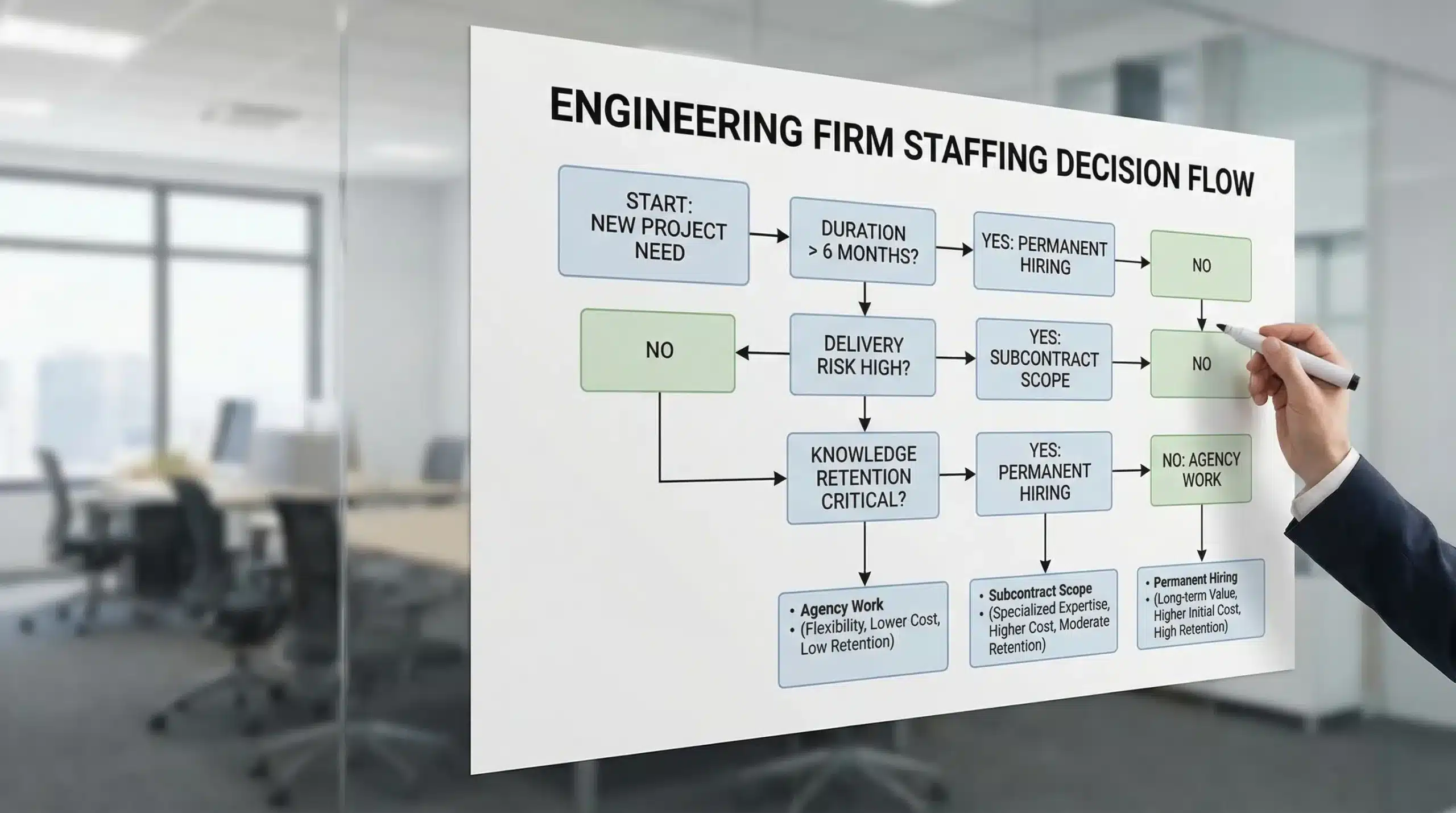
When engineering agency work pays off (high-ROI scenarios)
The best use cases share one trait: the cost of being understaffed is higher than the premium you pay for flexibility.
Scenario A: Project surge or peak workload (planned or unplanned)
Examples:
- A sudden increase in inspection hours after notice to proceed
- A design package deadline compresses
- Multiple awards land in the same quarter
Why it pays off: agency work converts fixed overhead into variable capacity and helps you avoid burning out top performers.
Scenario B: Schedule recovery on a critical path item
If a late deliverable risks a milestone, agency support can be a rational “schedule insurance” move.
To make it work, define the engagement as deliverables where possible (even if it is staffed hourly), for example:
- “Produce X sheets to Y standard by Z date”
- “Clear backlog of RFIs within two weeks under PM supervision”
Scenario C: Bridge coverage for a vacancy you cannot leave open
If a resident engineer, discipline lead, or PM leaves midstream, a short-term agency backfill can stabilize the project while you run a proper search.
This is often better than rushing a permanent hire based on limited evidence.
Scenario D: Specialized expertise for a narrow phase
Examples:
- Complex permitting or stakeholder phase
- Specialized modeling, temporary works review, or constructability support
This is where subconsultant-style engagement can be even stronger than time-based staffing because you are buying outputs.
Scenario E: New geography test
If you are exploring expansion (new DOT, new municipality, new client segment), agency or subcontract support can validate demand before you build permanent local leadership.
When engineering agency work usually does not pay off
Agency work is often used as a workaround for deeper hiring problems. It becomes costly when:
The role is leadership-critical
If the person owns client relationships, margin, team performance, and delivery outcomes, prolonged temporary coverage often increases risk.
In those cases, the stronger play is usually to invest in a rigorous permanent search process, especially when the cost of a mis-hire is high.
If you are evaluating search models for leadership roles, AES has a practical breakdown of retained vs contingent hiring that explains why incentives matter.
You are using agency talent to compensate for weak role definition
If the team cannot explain success beyond “we need a senior engineer,” agency work can turn into churn.
Before you staff, clarify:
- Top 3 outcomes the role must deliver
- Top 3 risks the role must reduce
- Who approves work and how quality is checked
The work is core IP or long-term systems ownership
If the person builds your standards, QA system, client playbook, or technical differentiators, rotating capacity creates fragmentation.
A simple cost model leaders can use (without false precision)
Comparing agency cost to direct hire salary is a common mistake because you are comparing two different things:
- Agency bill rate includes agency overhead, recruiting, and bench risk
- Employee cost includes benefits, payroll tax, downtime, management time, and turnover risk
Use a basic comparison like this:
| Cost element | Agency work | Direct hire |
|---|---|---|
| Upfront recruiting time | Low | Medium to high |
| Flexibility | High | Low |
| Ramp time | Medium | Medium |
| Quality variance | Medium to high (depends on vetting) | Medium (depends on hiring rigor) |
| Turnover risk | Medium (rotation happens) | Medium (but longer-term stability if fit is right) |
| Long-term cost (12+ months) | Often higher | Often lower |
The practical takeaway: agency work is a premium product. It is worth paying for when it avoids bigger losses (delay, missed revenue, burnout, bad permanent hires). It is less attractive when you are simply filling a steady-state seat.
How to make engineering agency work succeed (operating rules)
Most agency engagements fail for predictable reasons: unclear scope, weak onboarding, and slow review cycles. You can prevent that.
1) Assign a single accountable internal owner
Even if the agency provides talent, your firm must own outcomes. Identify:
- One supervisor who approves work
- One reviewer responsible for QA/QC
2) Define scope as “reviewable work packages”
Even for hourly engagements, break work into packages that can be checked weekly. This reduces billing drift and rework.
3) Standardize onboarding for temporary staff
Include:
- Your CAD standards and sheet templates
- File naming, document control, and permissions
- Safety orientation if field work is involved
- Client-specific standards where relevant
4) Put a handoff plan in writing
If the engagement ends abruptly, what gets transferred?
At minimum:
- Current status and next steps
- Assumptions and open issues
- Key contacts and decision history
- File locations and version control
5) Measure success with delivery metrics, not activity
Instead of “hours filled,” track:
- Cycle time to clear backlog
- First-pass QA acceptance rate
- Schedule adherence on assigned packages
How agency work fits into a smarter long-term hiring strategy
High-performing civil engineering firms typically run a hybrid model:
- Agency or subcontract support for short-term capacity spikes and specialized bursts
- Permanent hiring for delivery-critical leaders and long-horizon capability
If you notice you are repeatedly using agency work to cover the same leadership gaps, it is usually a signal to upgrade your permanent hiring system.
Two AES resources that help leaders quantify and reduce hiring risk:
- The Bad Hire Calculator to estimate the cost of getting the decision wrong
- Their overview of data-driven executive recruitment (how to move beyond resumes and gut-feel)
Frequently Asked Questions
Is engineering agency work the same as using a recruiting agency? Not exactly. Agency work usually refers to contract or temporary staffing (capacity for a period). Recruiting agencies can also be used for permanent hires, especially for leadership or hard-to-fill roles.
When should a civil engineering firm avoid agency work? Avoid relying on agency work long-term for roles that own client relationships, margins, safety-critical outcomes, or core QA/QC systems. Those roles typically justify a permanent hire.
Is it cheaper to hire an engineer directly than use an agency? Over longer horizons, direct hires are often more cost-effective, but agency work can be cheaper in the situations that matter most, for example avoiding project delays, burnout, and rushed mis-hires.
What’s the biggest risk with agency engineers? The biggest operational risks are unclear accountability and weak scope definition. The biggest compliance risks involve worker classification (especially with 1099 arrangements) and safety or licensing obligations.
How do I decide between staff augmentation and a subconsultant? Use staff augmentation when you need extra hands embedded in your process under your supervision. Use a subconsultant when you can define deliverables clearly and want to buy outcomes, not hours.
CTA: Need short-term capacity and long-term leadership stability?
If agency work is helping you “stop the bleeding” but you still need a permanent leader (PM, discipline lead, operations, or executive talent) to protect delivery and retention, consider running a structured, evidence-based search.
Alexander Executive Search specializes in civil engineering, infrastructure, and engineering recruitment, using tools like RoleDNA™ mapping and assessment-led shortlists to improve hiring outcomes. Explore their approach to choosing the right recruitment partner or start by pressure-testing the cost of a wrong hire with their Bad Hire Calculator.
OUR BLOG
Explore our latest articles
CONTACT US
Change starts with a conversation
Complete the form to get started. We’ll get in touch to discuss our services and your options with you ASAP.