
Hiring in civil engineering is rarely “just filling a seat.” The wrong project executive, discipline lead, or operations leader can create ripple effects across delivery, safety culture, client confidence, and margin.
That is why many engineering firms eventually ask a practical question: Should we use a contingency recruiter, or an executive search recruitment agency?
Both models can work, but they are built on different incentives and produce different outcomes. Below is a clear, decision-oriented comparison you can use to choose the right approach for your next hire.
What is contingency recruitment?
In a contingency model, the recruiter is typically paid only if a candidate they introduce is hired. The employer can often work with multiple recruiters at once for the same role.
In practice, contingency recruitment tends to be:
- Transaction-oriented (fill the vacancy quickly)
- Driven by readily available candidates (active job seekers)
- More common for roles where the market supply is strong, and the risk of a miss is lower
Contingency partners can be valuable when speed matters and the role is relatively easy to source.
What is an executive search recruitment agency?
An executive search recruitment agency typically works on a retained or exclusive basis, meaning the firm is engaged as a strategic partner to run a structured search. Payment is not solely dependent on placement, and the search firm is resourced to invest more time into discovery, market mapping, outreach, and assessment.
Executive search is most often used for:
- Senior leadership and critical technical leadership
- Roles with a small qualified talent pool
- Confidential replacements or sensitive leadership changes
- Hires where culture, behavior, and stakeholder leadership are as important as technical capability
Many executive search firms align with professional standards such as those promoted by the Association of Executive Search and Leadership Consultants (AESC).
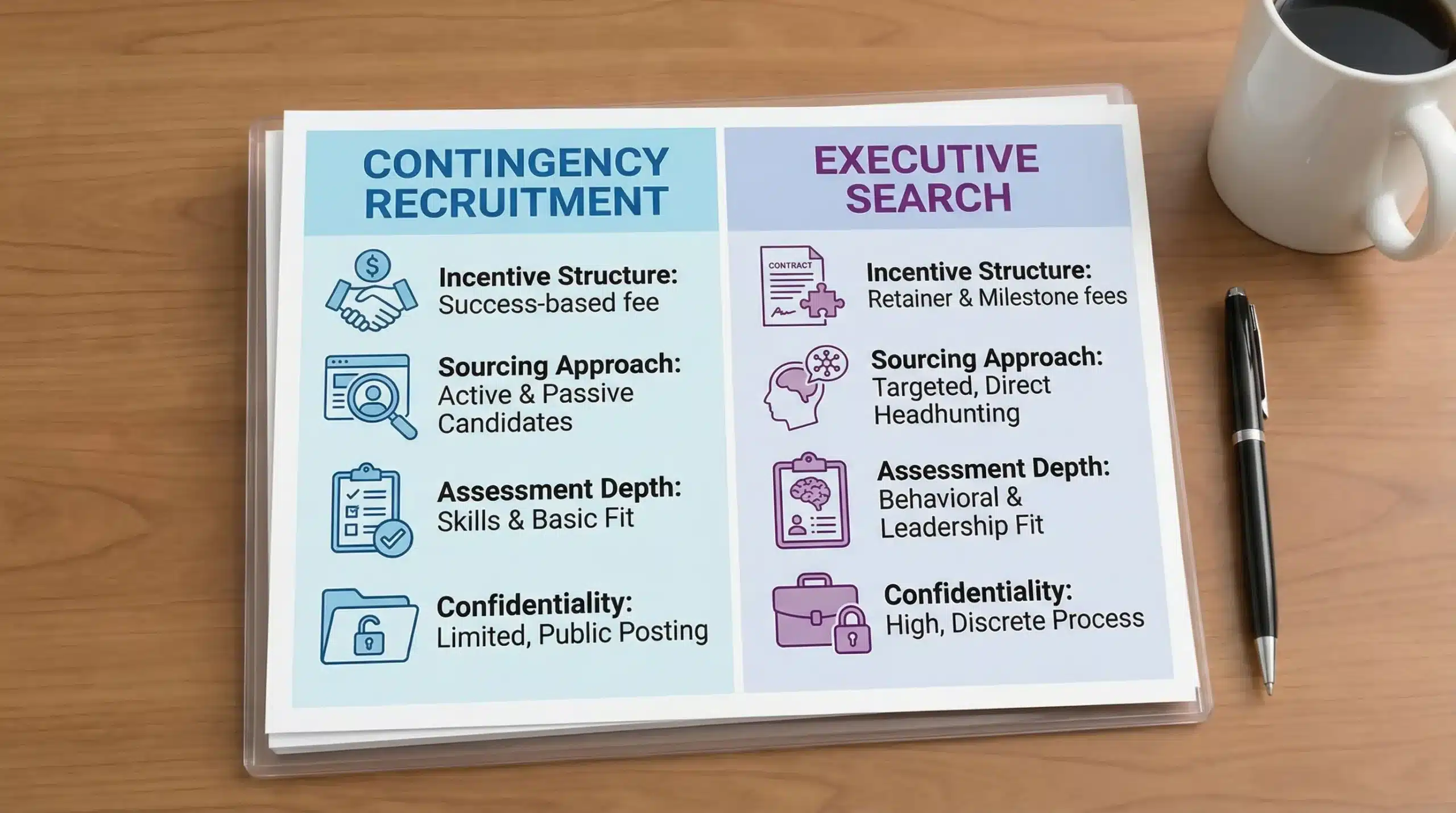
Executive search recruitment agency vs contingency: the key differences
The simplest way to compare these models is to look at what each one optimizes for. So, Executive Search Recruitment Agency vs Contingency?
1) Incentives and ownership
Contingency: The incentive is to place a candidate fast, because payment depends on a successful hire, and there may be competition from other recruiters.
Executive search: The incentive is to run a complete process and deliver the best match, because the search firm is engaged as a partner and has clear ownership of the search.
The difference matters most when your internal team needs the recruiter to do more than forward resumes, for example aligning stakeholders, pressure-testing leadership behaviors, and calibrating the market.
2) Candidate pool (active vs passive)
Contingency often over-indexes toward active candidates because they are easier to reach and move quickly.
Executive search is designed to reach passive, high-performing candidates who are not actively applying, but may move for the right scope, culture, and leadership.
In civil engineering, that passive market is often where you find the leaders with proven delivery under DOT constraints, complex stakeholder management, or specific design-build experience.
3) Search strategy (reactive vs proactive)
Contingency commonly starts from what is already available, candidates in a database, applicants, and people currently responding to outreach.
Executive search typically starts from the market: mapping target companies, identifying specific profiles, and approaching them directly.
If your role requires a rare blend (for example, multi-state transportation leadership plus strong business development plus a particular client network), proactive search becomes less optional.
4) Assessment depth and quality control
This is where outcomes can diverge sharply.
Contingency processes vary widely, but they tend to be lighter on structured assessment because the model does not always support deep upfront work.
Executive search commonly includes structured discovery, candidate benchmarking, and multi-layered assessment.
For example, Alexander Executive Search describes a data-driven process that goes beyond the resume, including behavioral profiling and job fit analysis (see their overview of data-driven executive recruitment).
5) Confidentiality and reputational risk
Contingency can create accidental “market noise” when multiple recruiters pitch the same role, especially if the vacancy is sensitive.
Executive search is often better suited to confidential situations, such as:
- Replacing an underperforming leader
- Building a new office or region quietly
- Upgrading a critical project role without disrupting client relationships
In leadership hiring, confidentiality is not just a preference, it is often risk management.
6) Process management and stakeholder alignment
Civil engineering hiring frequently includes multiple stakeholders: operations, discipline leads, project executives, HR, and sometimes clients.
Contingency usually has limited scope to run a full alignment process.
Executive search is more likely to formalize the “what success looks like” definition, keep stakeholders aligned, and reduce late-stage surprises like:
- “This candidate is great, but not for our culture.”
- “We actually need a different type of leader.”
- “We cannot agree internally, so we are pausing.”
7) Fee structure and what you are really buying
A common misconception is that contingency is always cheaper.
Yes, contingency fees can look smaller on paper, but the relevant cost question is broader: What is the cost of a miss? What is the cost of delay? What is the cost of churn?
If you want a practical way to quantify that risk, AES publishes a resource to estimate the impact of hiring mistakes (see the Bad Hire Cost Calculator).
8) Guarantees and risk-sharing
Guarantees vary by firm and should be verified contractually.
Some executive search providers offer stronger replacement terms because they have more control over the process and more confidence in the assessment.
AES, for example, references a 12-month replacement guarantee within their materials (see their guarantee overview).
Comparison table: executive search vs contingency
Use this table to align your internal decision-makers quickly.
| Dimension | Contingency recruitment | Executive search recruitment agency |
|---|---|---|
| Engagement structure | Often non-exclusive, multiple recruiters may work the same role | Often retained or exclusive, clear ownership |
| Primary incentive | Speed to placement | Quality, fit, and long-term success |
| Candidate sourcing | More active candidates, database-driven | Proactive market mapping and targeted outreach |
| Best for | Roles with larger talent supply and lower risk | High-stakes, niche, confidential, or leadership roles |
| Assessment depth | Often lighter, varies by recruiter | Typically deeper and more structured |
| Confidentiality | Can be harder to control | Typically stronger confidentiality controls |
| Stakeholder management | Limited | More consultative, alignment-focused |
| Risk of “good enough” shortlist | Higher | Lower (if the firm runs a rigorous process) |
Which one is right for a civil engineering firm?
The best choice depends on role criticality, scarcity, and the consequences of a wrong hire.
When contingency recruitment can be the right tool
Contingency can work well when:
- The role is relatively standardized and common in your market
- You have strong internal screening and interviewing capacity
- You need short-term speed and can tolerate a wider range of candidate fit
- The cost of a mismatch is manageable
Typical examples might include some mid-level roles when you have a stable pipeline and well-defined onboarding.
When an executive search recruitment agency is the safer bet
Executive search is usually a better fit when:
- The role is a “multiplier” position (it affects teams, profit centers, client relationships)
- The talent pool is thin or highly competitive
- You need to approach passive candidates who are not applying
- Cultural alignment and leadership behavior are crucial
- The hire must reduce risk, not just fill a vacancy
In civil engineering, this often includes roles like regional leadership, discipline directors, project executives on marquee programs, or specialized technical leaders where replacement cost and schedule risk are high.
A practical decision framework (ask these questions internally)
If your leadership team is split on which model to choose, align on these questions first:
How expensive is failure?
If the wrong hire creates rework, client churn, or delivery instability, you are not buying recruitment; you are buying risk reduction.
How scarce is the candidate profile?
When the profile is rare, your real competitor is not another employer’s job post. It is the candidate’s current situation.
Do you need proactive headhunting?
If the best candidates are employed and performing, they will not be applying. A search process must go to them.
Is confidentiality important?
If this hire affects internal trust or client perception, treat confidentiality as a requirement, not a preference.
Do you need evidence, not intuition?
If your firm has been burned by “great on paper” hires, prioritize structured assessment and benchmarking.
What to ask any recruiter before you sign
Regardless of model, vet your partner like you would vet a senior hire.
Process questions
- How will you define success in the role before sourcing begins?
- How do you assess leadership behaviors and culture fit, not just technical skill?
- What is your plan to reach passive candidates?
- How will you present candidates (resume only, or deeper evidence)?
Market questions
- What compensation realities are you seeing right now for this role?
- Which competitor firms are you likely to source from, and why?
- What are the most common candidate concerns (relocation, backlog, leadership changes, hybrid work)?
Risk questions
- What guarantee or replacement terms do you offer?
- How do you handle off-limits conflicts?
- How do you keep the search confidential when needed?
Where Alexander Executive Search fits in this comparison
Alexander Executive Search positions itself closer to the executive search side of the spectrum, with a specialization in civil engineering, infrastructure, engineering, and oil and gas.
Based on their published process, firms often choose AES when they want more than resumes, including:
- Role alignment and structured definition work (including RoleDNA mapping)
- Multi-layer candidate assessment and behavioral profiling (see their data-driven executive recruitment approach)
- Decision support tools to quantify hiring risk (see the Bad Hire Cost Calculator)
- A published retention outcome (AES references 96% retention at 12 months) and a 12-month replacement guarantee
If you are evaluating partners for a leadership or niche technical hire, the most useful next step is to compare processes side by side: what evidence each firm produces before you interview, how they reach passive candidates, and how they reduce the probability of a costly mis-hire.
Frequently Asked Questions
Is an executive search recruitment agency only for C-suite roles? Not necessarily. Many firms use executive search for director-level and critical technical leadership roles where scarcity, confidentiality, or business impact is high.
Is contingency recruitment always lower cost? The fee structure can be lower, but the total cost depends on outcomes. If a fast placement becomes a bad hire, the downstream costs can exceed any upfront savings.
What does “retained” executive search mean? Retained search typically means the search firm is engaged on an exclusive basis with payment terms that support a full search process (role discovery, market mapping, outreach, and assessment).
How long does executive search take compared to contingency? It varies by role and market. Executive search often spends more time upfront on definition, mapping, and assessment, which can reduce time lost later to misalignment, restarts, or failed hires.
What should I look for in candidate assessment for engineering leadership roles? Look for evidence beyond the resume: structured competency evaluation, leadership behavior insights, reference validation, and alignment to how success will be measured in the role.
Need to choose the right hiring model for a critical engineering role?
If you are weighing an executive search recruitment agency vs contingency for a leadership or high-impact technical hire, AES shares their methodology openly and can walk you through what a structured search looks like in practice.
Explore AES’s approach to data-driven executive recruitment or quantify the financial risk of a mis-hire with the Bad Hire Cost Calculator. When you are ready, you can start a confidential conversation via the contact options at AES Recruitment.
OUR BLOG
Explore our latest articles
CONTACT US
Change starts with a conversation
Complete the form to get started. We’ll get in touch to discuss our services and your options with you ASAP.