
Civil engineering leaders are not “nice to have” hires. They directly influence bid strategy, safety performance, client confidence, schedule recovery, margin discipline, and whether project teams stay intact through the next cycle of work. That is why executive recruitment for civil engineering needs to look more like risk management than resume collection.
In 2026, the firms winning consistently are treating executive hiring as a delivery-critical system: define success clearly, target the real market (including passive talent), assess for leadership behaviors that predict performance, move fast with disciplined governance, and protect the business with references, compliance, and structured onboarding.
What executive recruitment means (and why civil engineering is different)
Executive recruitment is the structured search, assessment, and closing of leaders who materially change outcomes, typically from senior project leadership up through COO/President and niche technical executives.
In civil engineering and infrastructure, “great” looks different than it does in many white-collar sectors because leaders sit at the intersection of:
- Delivery reality (means-and-methods, staffing curves, change orders, claims avoidance)
- Client risk (DOTs/municipalities, design-build partners, primes, utilities)
- Safety and compliance (culture, field rigor, subcontractor discipline)
- Geography and licensing (regional reputations, PE expectations, relocation constraints)
A great search therefore starts with a simple question: What must be true 12 months from start date for this hire to be called an obvious win?
The 8 hallmarks of great executive recruitment for civil engineering
Below are the signals that separate high-performing executive recruitment from “busy” recruitment.
1) A success profile anchored to delivery outcomes, not a generic job description
Great searches begin with a measurable definition of success. That usually includes:
- The business problem (for example, stabilize a region, improve hit rate, rescue schedule performance)
- The operating context (portfolio type, contract mix, backlog health, team maturity)
- The leadership behaviors required (decision style, conflict posture, accountability rhythm)
- The failure modes to avoid (political mismatch, safety complacency, weak client messaging)
Specialist firms often formalize this with structured role mapping (Alexander Executive Search describes this as RoleDNA mapping) so every stakeholder is scoring against the same definition of “great.”
2) Real market mapping (including passive talent) and an evidence-backed target list
If a recruiter shows up with “who applied,” it is not executive recruitment.
Great looks like a market map that identifies:
- Competitor and adjacent-firm talent (consulting, EPC, owners-rep, CM)
- Leaders tied to the contract types you run (DBB vs design-build vs progressive DB)
- Regional credibility and relationships (where reputations travel)
- Motivation triggers (growth ceiling, succession timing, commute realities, equity appetite)
This is where sector specialization matters. Without it, sourcing becomes random, and random is expensive.
3) Assessment that predicts performance under civil engineering pressure
Executive recruitment fails when assessment stops at “seems sharp” and “has done similar.” Civil engineering leaders need to perform under ambiguity: claims pressure, client escalation, staffing shortages, field safety incidents, or a design package that arrives late.
A strong assessment design typically includes:
- Structured, behavior-based interviewing (scored, not vibes-based)
- Technical validation tied to the role (delivery, PMO rigor, QA/QC expectations)
- Leadership and communication evaluation (stakeholder alignment, escalation clarity)
- Psychometric or behavioral assessment as one data point (used responsibly, not as a shortcut)
If you already know that behavioral fit is your biggest predictor of retention, you will recognize the themes in AES’s writing on why behavioral fit trumps skills alone.
4) Tight process governance (speed without sloppiness)
In 2026, slow searches lose candidates. Great executive recruitment is not “rushed,” but it is predictable.
Look for:
- A clear weekly cadence (client check-in, candidate pipeline review, risk flags)
- Defined decision owners (who can say yes, who is advisory)
- Interview design before outreach begins (scorecards, panel roles, time boxes)
When governance is weak, the process drifts, stakeholders change criteria midstream, and top candidates opt out.
5) A candidate experience that protects your brand and confidentiality
Executive candidates in civil engineering are often employed, visible in their markets, and cautious. Great recruitment protects them and you.
That means:
- Confidential outreach and disciplined information sharing
- A compelling leadership narrative (why now, why this role, what changes)
- Clear expectations and fast follow-up
Candidate experience is not soft. It directly affects your ability to recruit leaders who are not actively job hunting.
6) Offer strategy built for real constraints (comp, relocation, risk, and timing)
Executive offers in civil engineering often hinge on practical factors: travel load, office presence, project locations, bonus structure, and risk tolerance.
Great recruiters run pre-close conversations early so you do not discover deal-breakers after final interviews. They also help translate your offer into what the candidate hears as “I can win here.”
7) Risk controls: references, conflicts, and data privacy
Great executive recruitment reduces downside, not just time-to-fill.
Expect:
- Referencing that validates outcomes and leadership behaviors (not just employment dates)
- Conflict checks and off-limits transparency (especially in tight regional markets)
- Responsible handling of candidate data, storage, access controls, and retention practices
If your hiring process touches candidate assessments, background data, or cross-border recruiting, it is worth aligning your approach with strong privacy and data protection governance resources such as Privacy & Legal Management Consultants Ltd., especially when you operate across multiple jurisdictions and compliance expectations.
8) Onboarding that targets time-to-impact (not just “welcome aboard”)
The best executive recruitment does not end at acceptance. It connects hiring to integration.
Great looks like:
- A 30/60/90 plan tied to outcomes (client touchpoints, team assessment, delivery KPIs)
- Stakeholder alignment on what “good” looks like in the first quarter
- Early risk monitoring (where friction tends to emerge)
This is one reason specialist firms often talk about retention as an outcome metric, not a marketing line.
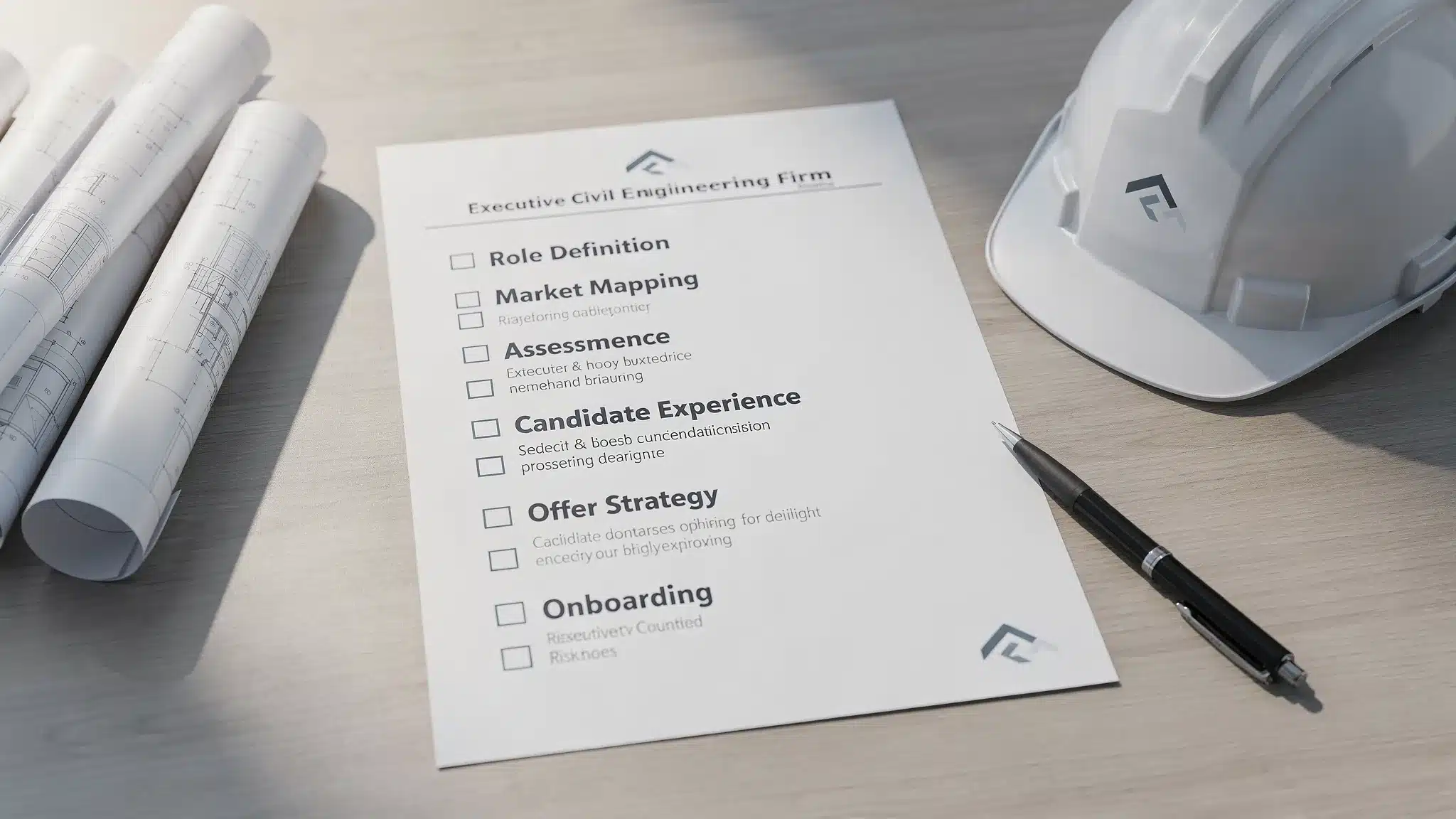
A practical scorecard: how to tell if an executive recruitment process is actually “great”
You do not need to guess. Use the table below to evaluate either your internal process or an executive search partner.
| Executive recruitment area | What “great” looks like in civil engineering | Evidence to request (or build internally) |
|---|---|---|
| Role definition | Success profile tied to delivery outcomes and behaviors | Written success profile, scorecard, aligned stakeholder sign-off |
| Market mapping | Named target companies and roles, with rationale | Market map summary, outreach plan, pipeline reporting |
| Candidate quality | Shortlist is small and sharp, not large and noisy | Candidate packs with validated outcomes, structured notes |
| Assessment | Structured interviews, behavioral data, technical validation | Interview guide, scoring rubric, assessment approach |
| Process speed | Predictable cadence and decision timeline | Search timeline, weekly governance rhythm, escalation rules |
| Candidate experience | Clear comms, confidentiality, high trust | Candidate feedback themes, drop-off reasons tracked |
| Risk management | Strong references, conflict checks, documented controls | Reference framework, off-limits policy, compliance checklist |
| Onboarding linkage | Integration plan tied to time-to-impact | 30/60/90 template, stakeholder alignment plan |
| Outcome measurement | Retention and performance indicators tracked | 12-month retention, time-to-productivity, hiring manager NPS |
If a provider cannot show artifacts like these, the process may rely more on intuition than on repeatable execution.
The metrics that matter (and the ones that mislead)
Most leadership hiring teams over-index on time-to-fill. Speed matters, but speed without quality is just faster risk.
Consider tracking a small set of executive recruitment metrics that reflect business outcomes:
- 12-month retention (and regretted attrition): Did the hire stay, and would you rehire them?
- Time-to-productivity: When did the leader independently own delivery, clients, and team rhythm?
- Quality of slate: How many candidates met the success profile on first submission?
- Process stability: How often did requirements change after kickoff, and why?
- Offer acceptance rate: Are you losing finalists due to avoidable misalignment?
Alexander Executive Search publicly emphasizes retention (for example, a 96% 12-month retention figure across placements) and uses assessment-led methods. Whether you work with AES or another specialist, demand outcome metrics that match how your firm measures delivery success.
Common “almost great” executive recruitment patterns (and how to fix them)
Pattern: The role is defined by titles, not by outcomes
If your spec reads like a job posting, you will attract applicants, not necessarily the leader you need.
Fix: Build a delivery-based success profile first, then write the spec.
Pattern: Interviews are unstructured and stakeholders score differently
Unstructured interviews produce confident decisions, not correct ones.
Fix: Use a single scorecard, with defined competencies and “evidence required” prompts.
Pattern: The process is slow because nobody owns decisions
Executive candidates interpret slow movement as internal dysfunction.
Fix: Assign a decision owner, pre-book interview blocks, and set a weekly governance rhythm.
Pattern: References are treated like a formality
For civil engineering leaders, references are where you validate leadership under pressure.
Fix: Ask references for specific examples tied to your success profile (schedule recovery, client escalation, safety leadership, team retention).
Pattern: The offer is negotiated at the end instead of managed throughout
Late-stage surprises are the #1 reason “perfect” candidates disappear.
Fix: Run pre-close conversations early and document non-negotiables.
What to expect from a specialist executive recruitment partner in civil engineering
A specialist partner should reduce ambiguity and risk. Practically, that means you should expect a process that includes:
- Upfront role discovery and success profiling
- Proactive headhunting, not just database searching
- Evidence-based assessment (often including behavioral tools)
- Transparent shortlisting (many specialist firms now provide online candidate profiles)
- Risk controls, and for some partners, a replacement guarantee
If you want to see how this is framed in an engineering-specific way, AES has several useful resources worth reviewing internally before you engage any firm, including their guide on how to choose an executive search agency for engineering and their overview of data-driven executive recruitment. If your leadership hiring has been expensive in hidden ways, their bad hire calculator can also help quantify downside in a board-friendly format.
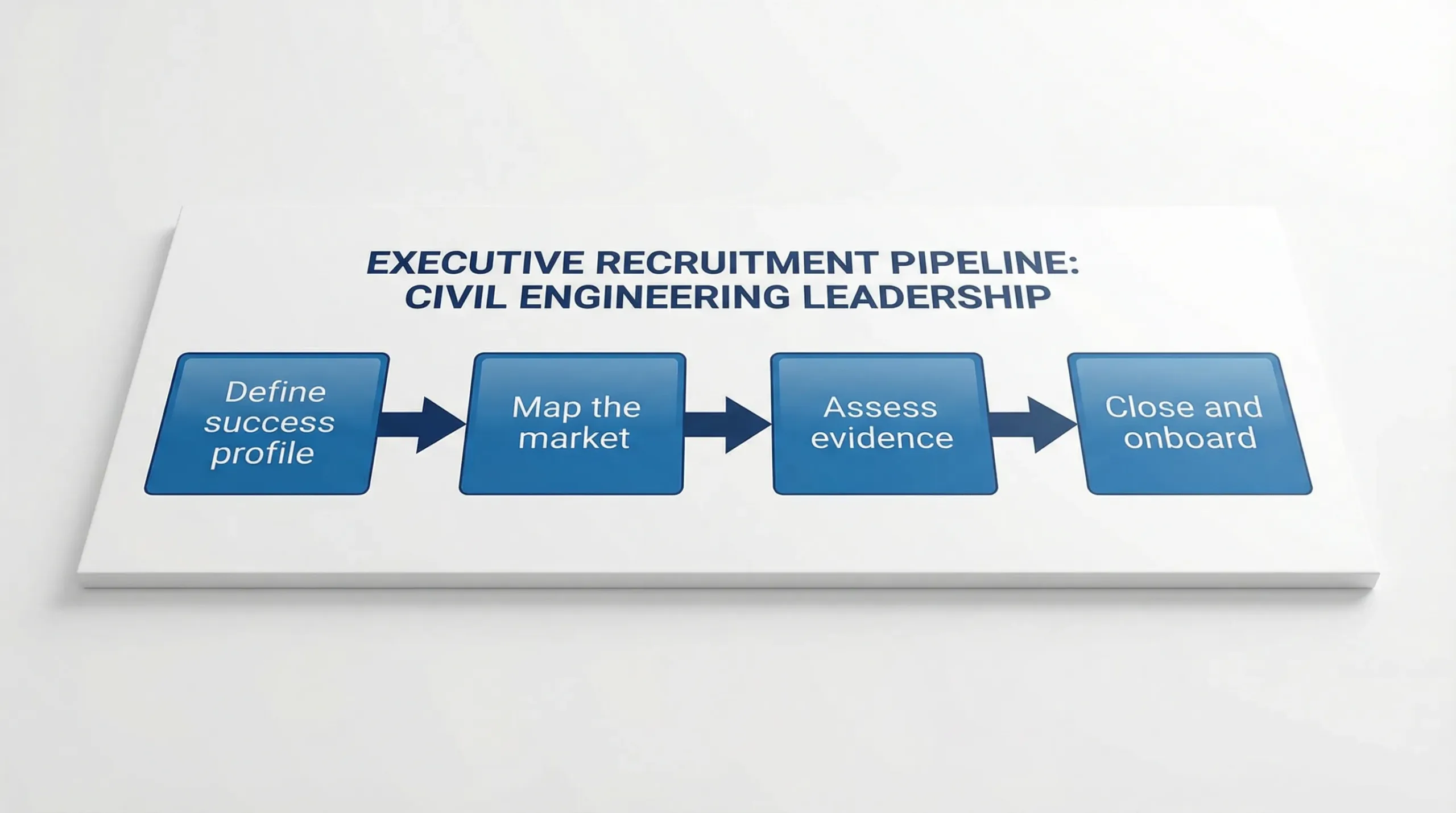
A simple definition of “great” you can use in your next hiring meeting
If you need one sentence to align your team:
Great executive recruitment for civil engineering delivers a leader who improves delivery outcomes, integrates fast, and stays, because the search was built on a measurable success profile, real market mapping, evidence-based assessment, and disciplined governance.
When you hold your process (or your search partner) to that standard, the noise drops away: fewer interviews, fewer late-stage surprises, better acceptance rates, and a higher probability that the new leader is still there when the next big program ramps up.
If you are pressure-testing your current approach, start by auditing two things: your success profile (is it measurable?) and your assessment design (does it predict performance, or just confidence?). Those two changes alone typically improve both speed and quality in executive recruitment.
OUR BLOG
Explore our latest articles
CONTACT US
Change starts with a conversation
Complete the form to get started. We’ll get in touch to discuss our services and your options with you ASAP.