
In civil engineering, a long time-to-hire is rarely “just an HR problem.” It becomes a delivery risk. When a key Project Manager, Resident Engineer, Estimator, or Practice Lead role sits open, schedules slip, change orders get harder to manage, and senior leaders spend more time firefighting than leading.
The good news is that cutting time-to-hire does not require lowering the bar. The fastest teams typically do two things well: they remove decision friction inside the business, and they validate candidates with better evidence early.
Below are practical recruiting solutions that consistently reduce time-to-hire for U.S. civil engineering and infrastructure firms, without trading speed for quality.
Why civil engineering time-to-hire drifts (even in well-run firms)
Civil engineering hiring slows down for reasons that are specific to the industry.
First, the talent pool is constrained. Licensure, domain specialization (transportation, water, land development, geotech), and client-facing credibility limit who can realistically perform in role. For licensed roles, requirements may include a Professional Engineer credential tracked by state boards and organizations such as NCEES (National Council of Examiners for Engineering and Surveying).
Second, the role definition is often fuzzy. Firms know they are overloaded, but they cannot always articulate whether they need a “doer,” a seller-doer, a people leader, or a turnaround operator. That ambiguity leads to slower shortlisting and more interview loops.
Third, the market is competitive, and infrastructure demand remains strong. Federal investment like the Infrastructure Investment and Jobs Act continues to support a busy project pipeline, which increases competition for proven leaders and specialized technical talent.
Finally, civil engineering hiring tends to involve many stakeholders: operations, discipline leads, client partners, and sometimes joint venture leadership. Without a structured process, coordination becomes the bottleneck.
Measure time-to-hire the way engineering teams manage projects
Most firms track “days open,” but that does not tell you where the delay lives. A more useful approach is to break the hiring cycle into stages, assign owners, and set internal service levels.
| Metric | What it measures | Common bottleneck | Who should own it |
|---|---|---|---|
| Time to approve role | Requisition approval to kickoff | unclear budget, unclear scope | leadership + finance |
| Time to shortlist | Kickoff to qualified shortlist | weak intake, slow sourcing | recruiter |
| Time to interview | Shortlist to completed interviews | calendar congestion | hiring manager |
| Time to decision | Final interview to offer decision | too many “nice-to-have” debates | hiring manager + panel |
| Time to close | Offer to acceptance | comp misalignment, slow counter handling | leadership + recruiter |
When you can see which stage is dragging, you can apply the right solution instead of pushing harder on everything.
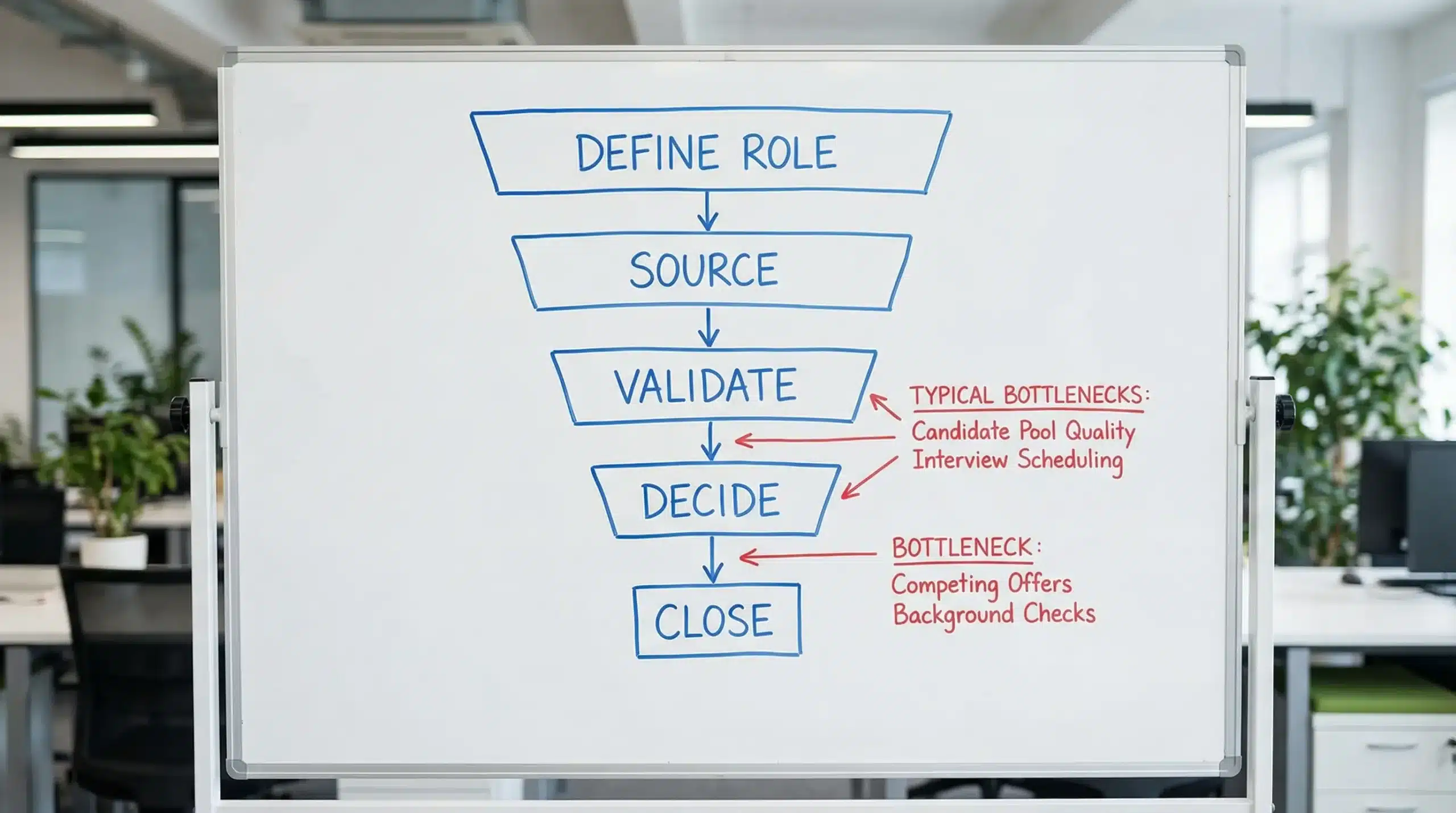
Recruiting solutions that cut time-to-hire (without lowering standards)
1) Start with a tighter role intake: define “success evidence,” not just responsibilities
The fastest hiring teams do not begin with a job description. They begin with a role success profile that makes decisions easier later.
A high-leverage intake aligns on:
- Must-have technical requirements (licenses, design tools, project types, client sectors)
- Critical leadership behaviors (how the person leads, communicates, handles pressure)
- Commercial expectations (utilization, backlog support, client-facing responsibilities)
- Non-negotiables (location, travel, clearance, schedule, safety expectations)
- Compensation range and approval authority (so offers do not stall)
Alexander Executive Search (AES) describes this as role mapping, including its RoleDNA mapping and structured role definition methods used in engineering recruitment. If you want an example of how this looks in practice, their overview of a more evidence-based approach goes deeper in Why Alexander Executive Search Goes Beyond the Resume.
2) Build a market map before you post (especially for leadership and niche disciplines)
Job ads rarely reduce time-to-hire for senior civil engineering roles because most qualified candidates are not actively applying. They are delivering projects.
A faster approach is market mapping: identify target firms, titles, and adjacent backgrounds, then start structured outreach immediately. This cuts time because you are not waiting for inbound applicants to appear, and you avoid weeks of “we got resumes, but none fit.”
In practice, market mapping works best when it includes:
- Competitor and adjacent-industry targets (consulting, owners’ reps, design-build, EPC)
- Geographic reality checks (commute vs relocation vs hybrid expectations)
- Compensation calibration (so you do not learn the market is higher after finalists)
AES positions this as a core part of its search strategy and global talent reach in engineering and infrastructure recruitment.
3) Replace resume-only screening with early proof (portfolio, project stories, and structured evidence)
Time-to-hire stretches when interviews become discovery sessions. You can compress the cycle by gathering better proof before the first live interview.
Examples of “early proof” that accelerates decisions:
- A short, structured project list (project size, delivery model, constraints, outcomes)
- Role-relevant competency questions answered in writing (so panels compare apples to apples)
- License and eligibility validation early (especially if multi-state work is involved)
- A brief candidate introduction video, when appropriate, to test communication and commitment
This is one area where AES’s platform-style candidate presentation (videos, assessments, summaries) is specifically designed to speed stakeholder review. Their explanation of a data-driven, assessment-backed process is outlined in How Alexander Executive Search Removes the Guesswork from Recruitment.
4) Use structured assessments to reduce interview loops, not add process
Many firms worry that assessments slow hiring down. In reality, the right assessments reduce time because they prevent “extra interviews to be sure.”
The key is to use assessments to answer a specific question:
- Is this person likely to lead teams effectively in your environment?
- Do they match the behavioral demands of the role (stakeholder management, urgency, detail)?
- Are there predictable derailers under stress?
AES references psychometric methods (including McQuaig behavioral profiling) to benchmark candidates for fit. Done correctly, this reduces the need for a third and fourth interview that exists only because the panel is uncertain.
5) Design an interview architecture that matches civil engineering decision needs
If you want to cut time-to-hire, your interview plan must be engineered like a project plan.
A common pattern that works for many civil engineering firms is:
- One structured technical and delivery interview (project execution, QA/QC mindset, codes)
- One structured leadership and stakeholder interview (client communication, team leadership)
- One final “close and align” conversation with the decision maker (scope, expectations, offer readiness)
What slows hiring is not the number of interviews alone, but unstructured interviews that generate new questions each time. A scorecard tied to the role success profile keeps the panel aligned and reduces backtracking.
6) Centralize feedback and shortlist review so stakeholders stop becoming the bottleneck
Civil engineering firms often lose a week simply coordinating feedback across busy leaders.
A practical recruiting solution is to centralize candidate data and feedback in one place so reviewers can evaluate asynchronously. This is where modern “candidate pack” and digital review workflows consistently cut days (sometimes weeks) out of the cycle.
AES emphasizes this advantage in its technology-enabled process, contrasting it with slower, fragmented hiring in Why AES Outperforms Paper-Based Recruitment Methods.
7) Pre-close earlier: treat offer acceptance as a process, not an event
In civil engineering, offers fall apart for predictable reasons: compensation misalignment, relocation reality, counteroffers, or uncertainty about workload and stability.
You shorten time-to-hire when you start closing before the final interview.
That means confirming, early:
- Compensation expectations and what is included (bonus, vehicle allowance, overtime policy where relevant)
- Work model and travel realities (project sites, multi-office support)
- Start date constraints (project handoffs, notice periods)
- Deal-breakers (licensure timeline, client relationship conflicts, non-competes)
This reduces last-minute renegotiations that drag out the close stage.
Match the recruiting model to the role, because the wrong model creates delays
Not every vacancy needs the same recruiting approach. Time-to-hire often suffers when the model does not match the role’s seniority, scarcity, or confidentiality.
| Recruiting approach | Best fit in civil engineering | Time-to-hire risk | Typical reason it slows down |
|---|---|---|---|
| Internal recruiting + job ads | high-volume, well-defined roles | medium | inbound volume, low fit, slow screening |
| Contingency recruiting | some mid-level roles | medium to high | speed incentives can reduce depth of validation |
| Retained search / specialist partner | leadership, niche technical, confidential | lower (when run well) | requires strong kickoff, but reduces rework later |
If your business is losing weeks to misaligned shortlists, the real fix is not “more resumes.” It is a better search strategy and clearer evidence of fit.
A 30-day hiring sprint template for critical roles
This is a practical structure many firms use to compress the cycle without sacrificing diligence.
Days 0 to 3: Role alignment and decision setup
Lock the success profile, compensation range, interview panel, and scorecard. Confirm who can approve an offer and what the approval path is.
Days 4 to 10: Market mapping and outreach
Build the target list and begin proactive outreach. Start reviewing early proof (project lists, structured questions) so you can prioritize the most aligned candidates quickly.
Days 11 to 20: First-round interviews and evidence collection
Run structured interviews, complete reference-style validation where appropriate, and keep feedback centralized so the panel can decide quickly.
Days 21 to 30: Final interviews and close
Move fast on finalists, pre-close, and prepare the offer before the final conversation whenever possible. If you require additional sign-off, schedule it in advance rather than waiting until after the final interview.
This timeline is not a promise. It is a planning framework. The point is to remove idle time between stages.

Where specialist partners shorten time-to-hire the most
A specialist civil engineering recruitment partner tends to accelerate time-to-hire in three high-impact ways:
First, they bring an active network and market map so sourcing starts immediately, not after a job post underperforms.
Second, they deliver higher signal early (structured evidence, behavioral alignment, competency validation), which reduces interview loops and internal debate.
Third, they reduce perceived hiring risk, which speeds decisions. AES, for example, emphasizes retention outcomes and includes a replacement guarantee in its process, along with a platform that helps stakeholders review candidates quickly. Their broader approach is summarized in Engineering Recruitment That Delivers Results.
If you are trying to justify investment in a faster, higher-assurance process, it also helps to quantify what delays and mis-hires cost your business. AES provides a practical tool for this in The True Cost of Bad Hires: Calculate Your Hidden Recruitment Losses.
A final note on speed: faster is only better if it stays right
Cutting time-to-hire is not about rushing. It is about removing avoidable friction: unclear role definitions, fragmented stakeholder feedback, resume-only screening, and late-stage offer surprises.
If you want to pressure-test your current hiring process for civil engineering roles, AES offers consultations and demonstrations of its assessment-led, platform-based recruiting workflow at aesrecruitment.com.
OUR BLOG
Explore our latest articles
CONTACT US
Change starts with a conversation
Complete the form to get started. We’ll get in touch to discuss our services and your options with you ASAP.