
Hiring a senior leader in civil engineering is not like hiring for most industries. Your “candidate” is often a revenue protector, a delivery risk reducer, and a client-relationship asset all in one. That is why choosing among executive recruitment companies is less about who can send resumes fastest, and more about who can consistently produce leaders that perform, stick, and scale with your backlog.
So what actually separates the best firms from everyone else?
The real job of executive recruitment (it is risk management)
At the executive and senior technical leadership level, a mis-hire rarely fails quietly. It tends to show up as:
- Slower project delivery because decisions bottleneck at the top
- Margin compression from rework, change-order friction, and avoidable claims
- Key client relationships weakening (especially in long-cycle public sector work)
- Team churn under a leader who looks strong on paper but weak in day-to-day execution
In other words, the best executive recruitment companies behave less like “talent suppliers” and more like risk managers for leadership outcomes.
If you want a grounded starting point for the financial side of the decision, use a structured tool (not gut feel) to quantify downside. AES provides a practical option here: the Bad Hire Calculator.
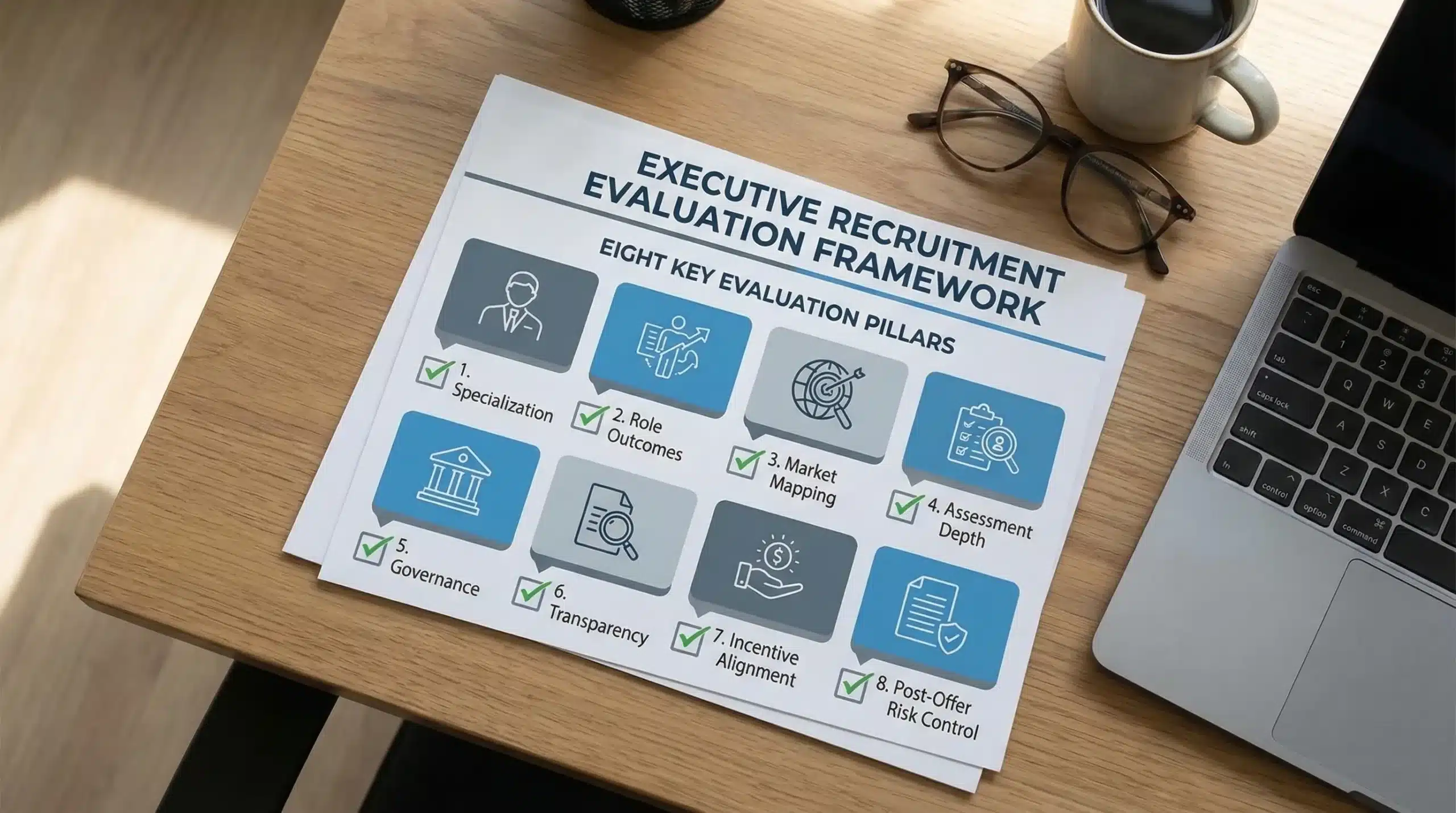
What separates the best executive recruitment companies
Below are the most reliable separators, especially for civil engineering, infrastructure, and adjacent sectors.
1) They specialize deeply, not broadly
A generalist can learn titles. A specialist understands the reality behind them.
In civil engineering, titles are often misleading across firms. A “Project Executive” in one contractor can be a true P&L owner. In another, it can be a senior PM with limited commercial authority. The best firms can interpret that context quickly because they live in the market.
Specialization shows up in how they discuss:
- Delivery models (design-bid-build, design-build, CMAR)
- Public sector constraints (procurement cycles, stakeholder complexity)
- Credential and license requirements (and what they signal, and what they do not)
- The real talent pools in your geography (including relocation likelihood)
2) They start with an outcomes-based role definition (not a job description)
The best executive recruitment partners will push you (politely, but firmly) to define the role in terms of measurable outcomes.
That often includes:
- The “6-month win” and “12-month win” (what must be true for this hire to be judged successful)
- Non-negotiable behaviors (how the leader operates under pressure)
- The leadership risks tied to your delivery environment (matrix teams, multiple PMs, multi-office delivery)
At AES, this concept is often framed through RoleDNA mapping, which is designed to clarify what “fit” means before outreach starts, not after interviews stall. If you want to see how evidence-based role definition connects to better hiring decisions, this page is a helpful reference: Data-driven executive recruitment.
3) They build a market map before they pitch candidates
Many executive recruitment companies sell “network.” The best ones can show market coverage.
A strong search begins with a view of the addressable market, typically including:
- Target company list (direct competitors plus adjacent talent sources)
- Role adjacency logic (who can do this job, even if they have never held the exact title)
- Compensation reality-check (what the market will actually require)
This is also where you see whether the firm can access passive talent consistently, not just applicants.
4) They validate leadership ability with evidence, not charisma
The strongest executive hiring mistakes often come from “executive theater,” a confident interview presence that collapses under delivery pressure.
Best-in-class firms reduce this risk by using an assessment stack that produces comparable evidence across finalists. Depending on the role, that can include structured behavioral assessment, competency-based interviews, and psychometric inputs.
AES is explicit about this multi-layer approach (including psychometric assessments) and why it improves retention, especially when technical competence alone is not the failure point.
If you want a deeper method-comparison lens (without turning it into a brand debate), this is a strong framework: Executive search firms: how to compare methodology and risk.
5) They run the search like a governed project (cadence beats chaos)
Executive hiring fails as often from internal friction as from lack of candidates.
The best executive recruitment companies bring process governance that keeps momentum without cutting corners, such as:
- A clear weekly cadence (client updates, outreach metrics, pipeline status)
- Stakeholder alignment early (decision rights, deal breakers, and scorecard)
- Structured interview architecture (so candidates are evaluated consistently)
When governance is strong, time-to-hire improves as a byproduct of clarity, not pressure.
6) They are transparent about what you are getting (and what you are not)
Quality firms make it easy to inspect their work.
You should expect real artifacts, not just a shortlist email. For example:
- A written role success profile
- Candidate comparisons on the same criteria
- Verified facts (scope of work, team size, delivery model, outcomes)
- Documented reference themes (not cherry-picked quotes)
AES also emphasizes secure, online candidate profiles and structured candidate packs in their methodology content, which is one practical way to reduce “he said, she said” in executive selection.
7) They align incentives with outcomes (retained search is usually part of this)
If a recruiter gets paid only when someone accepts, the system naturally rewards speed and volume.
For high-impact leadership roles, the best executive recruitment companies typically prefer a retained or exclusive model because it funds the work that actually improves outcomes (market mapping, passive outreach, assessment depth, and tighter process control).
If you are deciding between engagement models, this explainer is useful: Retained vs. contingent hiring.
8) They reduce post-offer risk (because that is where many “wins” die)
Even after you choose the right finalist, the highest-risk window often includes:
- Counteroffers
- Family constraints and relocation hesitation
- Late-stage misalignment on authority, scope, or success metrics
Top firms protect the close with proactive pre-closing, clarity on decision timelines, and structured onboarding support to reduce early churn.
A simple comparison table: average vs best-in-class
Use this table as a fast filter in your next set of intro calls.
| Dimension | Average executive recruitment company | Best-in-class executive recruitment company |
|---|---|---|
| Role intake | Job description review | Outcome-based success profile tied to delivery risk |
| Talent access | Applicants plus warm network | Market map plus consistent passive outreach |
| Candidate evaluation | Unstructured interviews | Comparable evidence across finalists (structured assessment) |
| Shortlist quality | Larger list to “show activity” | Small, decision-ready shortlist with real tradeoffs disclosed |
| Process | Reactive, availability-driven | Governed cadence with clear deliverables and decision rights |
| Transparency | Limited artifacts, mostly verbal | Written artifacts, verified claims, consistent scoring |
| Incentives | Paid only on placement, speed rewarded | Incentives aligned to quality and retention (often retained) |
| Risk controls | Short guarantee, limited coverage | Stronger risk-sharing, replacement options, onboarding support |
The 30-minute due diligence: questions that reveal quality
You can learn more in one structured call than in five generic pitch meetings.
| Ask this | What a strong answer sounds like | Red flag |
|---|---|---|
| “How will you define success for this role?” | Measurable outcomes, behavioral requirements, risk factors | “We will find someone with X years and Y skills” |
| “Show me how you build a market map” | Target firms, adjacency logic, coverage approach | “We have a big database” |
| “How do you assess fit beyond the resume?” | Clear, repeatable assessment steps | Vague “we are good judges of people” |
| “What artifacts will we receive with each finalist?” | Candidate pack, evidence, verified facts, references approach | Only resumes and a few bullets |
| “How do you keep this moving internally?” | Cadence, stakeholder alignment, interview architecture | “Just schedule interviews when you can” |
| “What is your retention or replacement approach?” | Defined risk-sharing and how it is triggered | No clarity, or heavy fine print |
What “best” looks like in practice for civil engineering leadership hires
For Presidents and senior business leaders, the right partner should make the hiring process feel calmer, not louder.
You should notice:
- Fewer surprises late in the process because issues are surfaced early
- Shortlists you can defend to your board or leadership team, with evidence
- Faster decisions because interviews are structured and comparable
- Higher stickiness because behavioral fit and role realities were tested upfront
AES positions its process around these ideas, especially assessment-led shortlists, RoleDNA mapping, and retention protection. If you want to compare what you are being sold by other firms to a concrete process, start here: How to choose an executive search agency for engineering.
Frequently Asked Questions
Are executive recruitment companies worth it for civil engineering firms? They are usually worth it when the role is delivery-critical, hard to replace, or expensive to get wrong. The value comes from risk reduction (better fit, faster time-to-impact), not just sourcing.
What should I expect from a high-quality executive search process? Expect structured role definition, market mapping, proactive outreach to passive candidates, evidence-based assessment, a small shortlist, and active support through offer and onboarding.
Is retained search always better than contingency for executive roles? Not always, but for leadership hires where confidentiality, assessment depth, and passive talent access matter, retained models often align incentives better and fund the work that drives outcomes.
How can I tell if a recruiter is just sending resumes? Ask what artifacts you will receive beyond resumes and how fit is assessed. If there is no clear assessment approach, no market map, and no structured process governance, you are likely buying volume.
What guarantee should I look for with executive recruitment companies? Look for clear, written terms that reflect shared risk and are realistic for the role level. Also evaluate what the firm does to prevent failure (role definition, assessment, onboarding support), not only what they promise after it happens.
How long does an executive search take in engineering? Timelines vary by scarcity, location, and stakeholder speed. A rigorous search often takes multiple weeks because market mapping, passive outreach, and assessment take time. The best firms keep it predictable with a tight cadence.
Talk to a specialist executive recruitment partner for civil engineering
If you are comparing executive recruitment companies for a delivery-critical role, the fastest way to de-risk the decision is to review methodology, not marketing.
Alexander Executive Search supports civil engineering, infrastructure, engineering, and energy employers with assessment-led searches designed to improve match quality and retention. You can explore their approach and start a confidential conversation at AES Recruitment, and if you want to quantify the downside first, use the Bad Hire Calculator.
OUR BLOG
Explore our latest articles
CONTACT US
Change starts with a conversation
Complete the form to get started. We’ll get in touch to discuss our services and your options with you ASAP.