
Hiring an executive is rarely “just filling a seat.” In civil engineering and infrastructure, one leadership hire can change how safely projects run, how accurately estimates are priced, whether claims are avoided, and whether your best PMs stay or leave.
That is why executive hiring firms exist: to reduce the odds of a high-impact mis-hire when the market is tight, the role is complex, or the hire needs to be discreet.
This guide breaks down when you actually need an executive hiring firm, what a good process looks like, and what you should have ready so the search runs fast without cutting corners.
What executive hiring firms actually do (beyond posting jobs)
At their best, executive hiring firms operate like an extension of leadership, not like an “inbox of resumes.” They help you:
- Define the role with a success profile (outcomes, leadership behaviors, decision authority, stakeholder map, risk factors).
- Build a targeted market map of where the right candidates are, including passive talent who are not applying.
- Approach candidates confidentially and professionally.
- Assess fit in a structured way (technical depth, leadership capability, motivations, culture, references).
- Manage a complex process (stakeholder alignment, interview design, offer strategy, and closing).
In practice, this typically looks more like project management than “recruiting.” The firm is accountable for search strategy, pipeline quality, and risk control.
Executive search vs. standard recruiting (quick clarity)
Many teams use the term “executive hiring firm” to mean anything from a contingency recruiter to a retained search partner. The difference matters because incentives and depth of work change.
- Contingency recruiting is usually success-fee based and optimized for speed and volume.
- Retained or exclusive executive search is optimized for accuracy, confidentiality, and candidate quality, with more time spent on role discovery and assessment.
If you want a deeper breakdown, see this comparison of executive search vs contingency recruitment (especially relevant for specialized engineering roles).
When you need executive hiring firms (and when you probably do not)
If your in-house TA team has strong reach in your niche, a clear success profile, and time to run a proactive search, you may not need an outside partner.
You are more likely to benefit from an executive hiring firm when the role is high-stakes, hard to source, or politically sensitive.
| Situation | Why it is hard to solve internally | What an executive hiring firm adds |
|---|---|---|
| Confidential replacement of a leader | Posting triggers rumors and retention risk | Discreet outreach, controlled messaging, anonymized market mapping |
| You have tried and failed (twice) | The role, comp, or story may be mis-positioned | Reality check on the market, recalibrated profile, stronger outreach strategy |
| “Unicorn” combination role (technical + commercial + leadership) | Most candidates look good on paper but fail in interviews | Upfront success profiling, structured assessment, evidence-based shortlists |
| Geographic constraints or relocation needed | Local network is too small | National (or global) targeting and relocation-ready candidate identification |
| Rapid growth, new office, or new service line | You need leaders who can build, not only manage | Market mapping for builders, playbooks, and leaders with scaling track records |
| M&A integration or turnaround | You need change leadership under pressure | Behavioral assessment, risk flags, and reference strategy focused on change events |
| Board-facing or client-critical role | One miss damages reputation and revenue | Tighter screening, stakeholder alignment, confidential referencing |
| Time-to-hire delays are now delivery risk | Projects are slipping, utilization is suffering | A focused search plan with defined weekly milestones and candidate SLAs |
A useful mental model: the more your hiring decision resembles a capital allocation decision, the more executive search makes sense.
What to expect from a high-quality executive hiring firm
Most disappointing experiences happen because expectations are vague. A strong firm will make the process explicit, including what they need from you and what you will receive each week.
Here is a realistic outline of what “good” looks like.
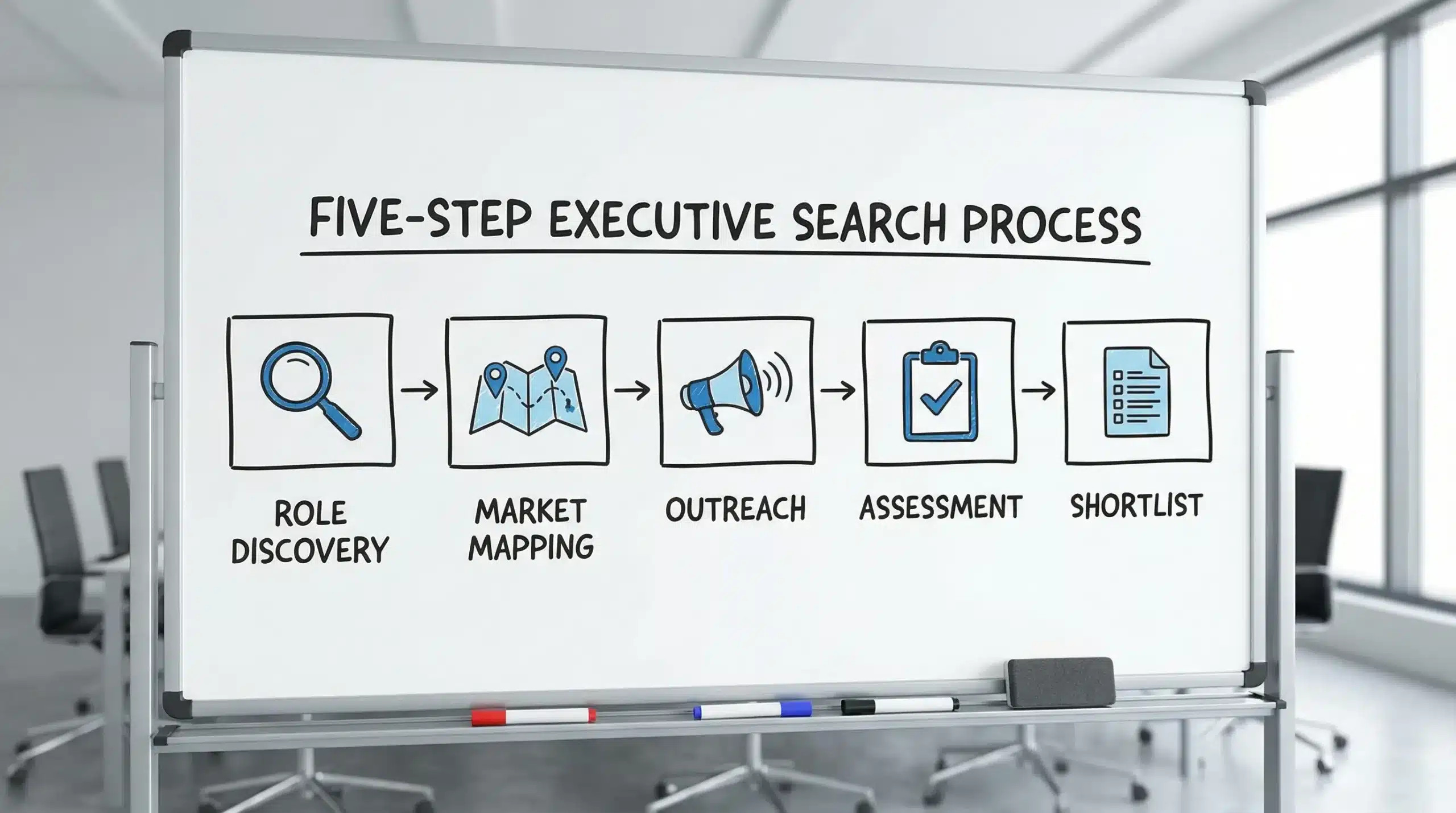
| Phase | What happens | What you should receive |
|---|---|---|
| Role discovery | Deep intake on outcomes, context, leadership behaviors, constraints | Written success profile and search strategy, not just a job description |
| Market mapping | Identify target companies, adjacent industries, and candidate segments | Market map (often anonymized), calibration on compensation and availability |
| Outreach and engagement | Direct approach to passive candidates, messaging refinement | Weekly pipeline update with themes (interest, objections, comp signals) |
| Screening and assessment | Structured interviews plus job-relevant assessments (as appropriate) | Evidence-based notes, not “gut feel,” and clear rationale per candidate |
| Shortlist | Narrow to a small number of highly aligned candidates | Shortlist that is genuinely interview-ready, typically 3 to 5 candidates |
| Client interviews | Interview plan, scorecards, scheduling, and feedback discipline | Interview architecture and decision checkpoints |
| References and closing | Back-channel where ethical, formal references, offer strategy | Referencing summary tied to success profile, closing plan and risk controls |
| Post-placement | Onboarding alignment and early risk monitoring | Follow-up cadence and retention-focused check-ins |
How long does it take?
For senior engineering and infrastructure leadership roles, a common range is 6 to 12 weeks from kickoff to accepted offer, depending on role complexity, interview availability, and relocation. If a firm promises “top candidates next week” for a niche leadership hire, you should ask how they are sourcing and what they are skipping.
What it costs (and what you are really paying for)
Fee structures vary, but executive hiring firms typically price based on the level of risk, time investment, and accountability.
Common models include:
- Retained search: a portion paid up front (or in milestones) to fund dedicated search work.
- Exclusive search: similar to retained, sometimes with more performance gating.
- Contingency: paid only on placement, usually less time spent on role discovery and assessment depth.
When comparing cost, avoid looking only at the recruiting fee. Consider the total cost of a mis-hire: recruitment spend, lost time, disruption, and project impact. For example, the Center for American Progress has cited replacement costs that can rise substantially for higher-paid roles (including estimates above 100 percent of salary for top earners), depending on role complexity and business impact (source).
That is why the most credible executive hiring firms talk about risk transfer (process rigor, transparency, guarantees) instead of “we have great candidates.”
Your responsibilities as the client (so the search does not stall)
Even the best executive hiring firm cannot compensate for slow decisions or unclear ownership. Before kickoff, align internally on:
- Decision owner: one accountable leader who can make tradeoffs and call the hire.
- Non-negotiables vs preferences: licensure requirements, travel load, client type (DOT, municipal, private), delivery model (DBB, DB, CMAR), etc.
- Interview availability: block time on calendars in advance.
- Compensation boundaries: salary range, bonus reality, relocation support, equity (if relevant).
- Fast feedback: commit to feedback within 24 to 48 hours after interviews.
If you want a practical way to quantify the downside of “close enough” hiring, AES provides a Bad Hire Calculator that can help frame the business case internally.
How to evaluate executive hiring firms (green flags and red flags)
You are not just buying access to candidates. You are buying a methodology that consistently produces hires who stay and perform.
| What to look for (green flags) | What to avoid (red flags) |
|---|---|
| They challenge your brief respectfully and improve it | They accept every requirement without testing the market reality |
| They show you how they will source, not just “database + LinkedIn” | Vague sourcing claims and heavy reliance on inbound applicants |
| They use structured assessment tied to role outcomes | Unstructured interviews and “I liked them” summaries |
| They provide weekly reporting and clear next steps | Silence between candidate submissions |
| They can explain how they reduce offer-decline risk | “We just send candidates and you interview them” |
| They can share anonymized examples of deliverables (candidate packs, scorecards) | Everything is “proprietary,” so you cannot validate the process |
A quick test question: “What evidence will we have at shortlist stage that these candidates can do the job here?” If the answer is mostly opinions, keep looking.
What to expect specifically in civil engineering and infrastructure leadership hires
Generalist recruiters can place generalist roles. Civil engineering leadership is rarely general.
Strong executive hiring firms in this space will understand, and screen for, things like:
- Delivery economics: utilization, backlog quality, write-offs, margin management, and resourcing discipline.
- Client and pursuit credibility: ability to win and retain DOT, municipal, or private clients, and to lead pursuits without burning teams.
- Risk posture: safety leadership, QA/QC, claims awareness, contract administration maturity.
- Technical authority and governance: when to escalate, how decisions are made, and how standards are enforced across offices.
- Leadership behaviors under pressure: how the leader communicates in conflict, handles accountability, and manages upward.
This is also where structured tools can add value. For example, Alexander Executive Search describes using RoleDNA mapping and behavioral assessment to benchmark candidates against the role’s success profile, with retention outcomes published on their site (for more on methodology, see their overview of data-driven executive recruitment).
What “good” looks like for candidate experience (and why it matters)
Senior candidates evaluate you as much as you evaluate them. If the process is messy, unclear, or slow, you will lose the best people to competitors with a tighter process.
A quality executive hiring firm will help you:
- Tell a consistent story across interviewers.
- Run interviews that feel rigorous but respectful.
- Keep momentum without pressuring candidates into blind commitments.
This matters across industries, whether you are hiring a regional transportation leader or a GM for a built-environment business like a manufactured home retailer in San Antonio. Executive candidates expect clarity, seriousness, and follow-through.
Getting started: the minimum inputs that make searches work
If you want to move quickly with an executive hiring firm, show up with more than a job description. Bring:
- A one-paragraph description of “why this role exists now.”
- The 3 to 5 outcomes you need in the first 12 months.
- The stakeholder map (who the leader must influence, internally and externally).
- The constraints you will not bend (location, travel, licensure, client clearance requirements).
- The tradeoffs you will accept (for example, local network vs national network, technical depth vs growth leadership).
From there, expect the firm to pressure-test assumptions, calibrate the market, and translate your needs into a search strategy you can inspect.
A practical expectation to set: fewer candidates, better evidence
If you are used to high-volume recruiting, executive search can feel slower at first because you see fewer profiles. That is usually a feature, not a bug.
You should expect:
- A smaller shortlist.
- More substantiated assessment.
- Clearer decision-making.
That combination is what reduces mis-hires, improves retention, and protects delivery.
If you are hiring senior civil engineering, infrastructure, or energy leaders and want a process built around evidence, not guesswork, Alexander Executive Search outlines their approach and retention metrics across their civil engineering recruitment resources at AESRecruitment.com.
OUR BLOG
Explore our latest articles
CONTACT US
Change starts with a conversation
Complete the form to get started. We’ll get in touch to discuss our services and your options with you ASAP.