
Hiring in civil engineering is rarely “just hiring.” One wrong Project Executive, Discipline Lead, or VP of Operations can create schedule slip, client dissatisfaction, rework, safety exposure, and a second vacancy right when your backlog is peaking.
That’s why choosing among engineering recruiting companies should not start with fee comparisons. It should start with a fast, evidence-based vetting conversation that tells you one thing: Will this firm reduce hiring risk, or simply move resumes?
This guide gives you a 30-minute vetting method you can use on a first call to separate true specialists from generalists.
What you can realistically learn in 30 minutes
In half an hour, you will not validate every detail of a recruiter’s network, research depth, or assessment science.
You can validate whether they:
- Understand civil engineering and infrastructure delivery realities (utilization, backlog, public vs private work, JV risk, safety culture, claims, client politics).
- Run a repeatable process that produces decision-grade evidence, not just “good vibes.”
- Measure outcomes (retention, time-to-fill, shortlist quality) and can show how they manage hiring risk.
The goal is not to “pick the winner” in 30 minutes. The goal is to quickly identify who deserves the next step.
The 7-minute pre-screen (before you even take the call)
Do this quick scan so your live call can focus on the hard questions.
Check for sector specificity (not just a logo wall)
Look for proof they consistently recruit in engineering and infrastructure, not “engineering + IT + finance + healthcare.” Generalist firms can still place engineers, but they often lack the domain context that protects you from mis-hires.
Look for evidence of methodology
On their site or proposals, do they clearly explain how they:
- Build the success profile
- Map the market (including passive leaders)
- Assess candidates beyond the resume
- Provide references and verification
- Manage post-offer risk
If the method is “we source, screen, and send,” your 30-minute call should be very short.
Confirm they can recruit your level
Many firms say “executive search” but primarily work mid-level roles. Your call should confirm whether they routinely fill:
- Delivery-critical leadership (PMO, Operations, Construction Management, Program Leadership)
- Practice leadership (Transportation, Water, Aviation, Geotech, CEI)
- Revenue leadership (BD Directors, Market Sector Leaders)
- C-suite and succession roles
The 30-minute vetting call agenda (use this structure)
The fastest way to vet engineering recruiting companies is to time-box the conversation. Here is a practical agenda that works well for presidents and senior leaders.
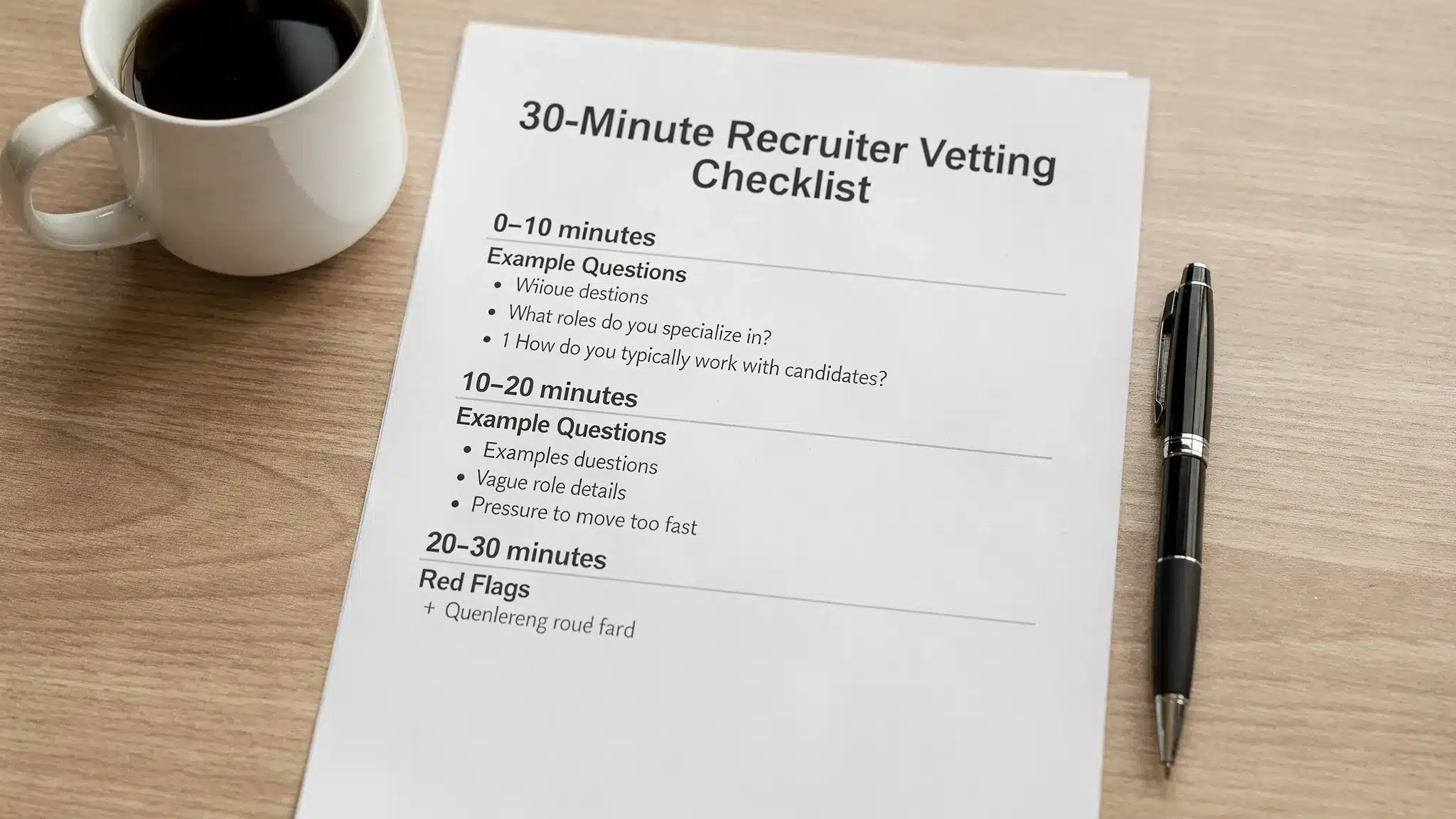
Minutes 0 to 10: Confirm they understand the job behind the job
Civil engineering leadership roles fail most often because the brief was wrong, not because the recruiter “couldn’t find talent.”
Ask:
“Walk me through how you build the role definition. What do you deliver after the intake?”
Listen for specifics like:
- A structured intake with multiple stakeholders (not only HR)
- Clarity on outcomes (what must be true in 6 and 12 months)
- Cultural and behavioral expectations (how decisions get made, how conflict is handled, pace, client interaction)
Red flags:
- They jump straight into “titles,” “years of experience,” and software keywords.
- They cannot describe how they handle stakeholder misalignment (President wants growth, Ops wants risk reduction, PMs want bandwidth).
“What are the top 3 reasons this role typically fails in firms like ours?”
A specialist will answer with context (delivery cadence, client expectations, utilization pressure, weak handoffs between estimating and ops, matrix leadership). A generalist will answer with generic HR language.
Minutes 10 to 20: Validate sourcing reach and market mapping (not database browsing)
Your best candidates are often not applying.
Ask:
“What does your sourcing plan look like in week 1 and week 2?”
Look for:
- Market mapping (target firms, adjacent sectors, competitor analysis)
- Outreach approach that protects confidentiality when needed
- Ability to recruit passive candidates who are already delivering
“How do you handle off-limits and conflicts?”
This matters in engineering where relationships are tight and teaming partners shift from project to project. You want clear rules, documented up front.
“How many candidates do you typically speak to in order to deliver a shortlist of 3 to 5?”
You are not looking for a perfect number. You are looking for evidence they run a real funnel, not a “send whoever answers” process.
Minutes 20 to 30: Pressure-test their assessment, evidence, and risk controls
This is where top-performing firms separate themselves.
Ask:
“What evidence do we get with each finalist, besides a resume?”
High-quality answers include artifacts like:
- Structured competency evidence (projects, metrics, budgets, contract types, team sizes)
- Leadership and communication assessment
- Behavioral or psychometric inputs (when appropriate)
- Reference strategy (who they speak to, what they validate, how they document it)
“How do you reduce the risk of a bad hire beyond interviews?”
If they say, “We’re good judges of character,” you are buying gut feel.
A more robust answer explains how they test for role fit, leadership style, motivation, and risk indicators, and how they present findings so your team can make consistent decisions.
“What happens after acceptance?”
Post-offer risk is real: counteroffers, delayed resignations, and culture shock. You want to hear about structured pre-close, stakeholder alignment, and onboarding coordination.
If you are relocating or hiring into high-pressure environments, it is also reasonable to ask what support resources are encouraged for executive transitions. Some leaders benefit from proactively establishing care in a new city, for example accessing comprehensive psychiatric services in NYC for anxiety, depression, ADHD, or post-injury cognitive symptoms. A thoughtful recruiting partner will not act as a clinician, but they should respect the human realities that affect retention.
The “show me” artifacts to request after the call
If the call goes well, ask for proof. You are not being difficult, you are doing due diligence.
Request these items (anonymized is fine):
- A sample candidate packet (what you actually see when deciding): summary, evidence, assessment outputs, and references format.
- A sample weekly update: what they track, how they report pipeline, and how issues are surfaced early.
- Their process map: from intake to shortlist to close.
- Outcome definitions: how they measure success (12-month retention, 24-month retention, time-to-productivity, “regretted attrition”).
- Guarantee or risk policy (if offered): clear terms, not vague assurances.
If a firm cannot provide any real artifacts, you are likely dealing with a resume broker.
A 30-minute scorecard to compare engineering recruiting companies
Use a simple rubric so you are not swayed by confidence, charisma, or brand names.
| Category | What “strong” looks like | What to watch out for | How to score quickly (1 to 5) |
|---|---|---|---|
| Role discovery | Multi-stakeholder intake, outcome-based success profile | Job description rewrite only | Ask what they deliver after intake |
| Market mapping | Named target universe, passive sourcing plan | “We have a big database” | Ask what week 1 looks like |
| Assessment depth | Structured evidence + behavior/leadership validation | “We interview them” | Ask what comes with each finalist |
| Transparency | Weekly reporting, clear stage gates, candidate packets | No reporting cadence, vague updates | Ask for a sample update |
| Risk controls | References, verification, post-offer plan, clear guarantee terms if offered | “Trust our instincts” | Ask how they reduce mis-hire risk |
| Engineering credibility | Understands delivery, backlog, utilization, safety, contracts | Generic HR talk | Ask why roles fail in firms like yours |
Add up your scores. More importantly, compare where firms are weak. One weak category can sink a critical search.
Red flags that matter specifically in civil engineering and infrastructure
A recruiter can be “good” in general and still be risky for engineering leadership. These are the red flags that tend to show up in this sector.
They cannot talk fluently about delivery environments
If they struggle with basics like public procurement vs private work, DOT/municipal client dynamics, CEI vs design roles, or why utilization pressure changes leadership behavior, they will miss fit.
They over-index on titles and under-index on scope
In engineering, titles are inconsistent. A “Project Manager” can mean $2M local site work or a $500M program with multiple subs and stakeholders.
Your recruiter should naturally ask about:
- Project types and delivery models
- Contract risk and claims exposure
- Team structure (matrix vs dedicated)
- Client-facing expectations
They sell speed as the only differentiator
Speed matters, but bad speed is expensive. Many firms can send resumes quickly. Fewer can deliver decision-ready finalists with verified evidence.
If you want a quick way to frame the cost of getting it wrong, AES provides a practical tool you can use internally: the Bad Hire Calculator.
They avoid measurable outcomes
Ask, “What does success mean to you in measurable terms?” If you hear only activity metrics (calls, submissions), you are not hearing quality metrics.
A quick decision rule: contingency vs retained search (in plain English)
Not every role needs a retained executive search model, but many engineering leadership roles should be treated as risk-managed searches.
A simple rule:
- Use a transactional model when the role is common, the downside risk is low, and you can validate fit quickly.
- Use a search model when the role is delivery-critical, confidential, scarce, or tied to major client outcomes.
If you want a deeper comparison tailored to engineering, AES has a helpful breakdown of executive search vs contingency recruitment.
What to do next (if a firm passes the 30-minute test)
If one or two firms score well, do not jump straight into a long contract. Instead, control risk with a structured next step.
Run a “method demo” before a full engagement
Ask them to walk you through:
- How they would define the role (what they need from you)
- The market map they would build (at a high level)
- What the candidate evidence pack looks like
- How decisions will be governed (cadence, stakeholders, stage gates)
This is different from a sales presentation. You are evaluating operating discipline.
Align on timeline and decision ownership
Many searches fail because the client side is not ready to decide. If your team cannot make time for weekly pipeline reviews and fast feedback, even the best recruiter will struggle.
For a practical benchmark of what an end-to-end process can look like, see The Recruitment Process for Engineering Leaders, Step by Step.
The bottom line
Engineering recruiting companies are not interchangeable. In civil engineering and infrastructure, the recruiter you choose becomes part of your risk management system.
A focused 30-minute vetting call can tell you whether a firm:
- Builds roles around outcomes, not keywords
- Reaches passive leadership talent with a real market map
- Provides evidence strong enough to make a decision without guessing
- Manages post-offer and retention risk intentionally
If you want a second set of eyes on your evaluation criteria, or you are hiring for a delivery-critical role where mis-hire cost is unacceptable, you can explore Alexander Executive Search’s approach to data-driven executive recruitment and compare it against your current vendors.
OUR BLOG
Explore our latest articles
CONTACT US
Change starts with a conversation
Complete the form to get started. We’ll get in touch to discuss our services and your options with you ASAP.