
Talent Acquisition Specialist: In 2026 is less about “filling seats” and more about protecting delivery, margin, and leadership continuity. In civil engineering and infrastructure especially, one missed hire can ripple into missed bid deadlines, stalled project mobilization, and burnout across project teams.
That is why the talent acquisition specialist role has evolved. The best TA specialists are not just sourcing machines. They are operators who translate business demand into a calibrated search, run a measurable process, and improve quality of hire over time.
Below is a practical breakdown of the skills, tools, and KPIs that define high-performing talent acquisition specialists today, with examples relevant to engineering and other hard-to-hire markets.
What does a talent acquisition specialist do (and how is it different from a recruiter)?
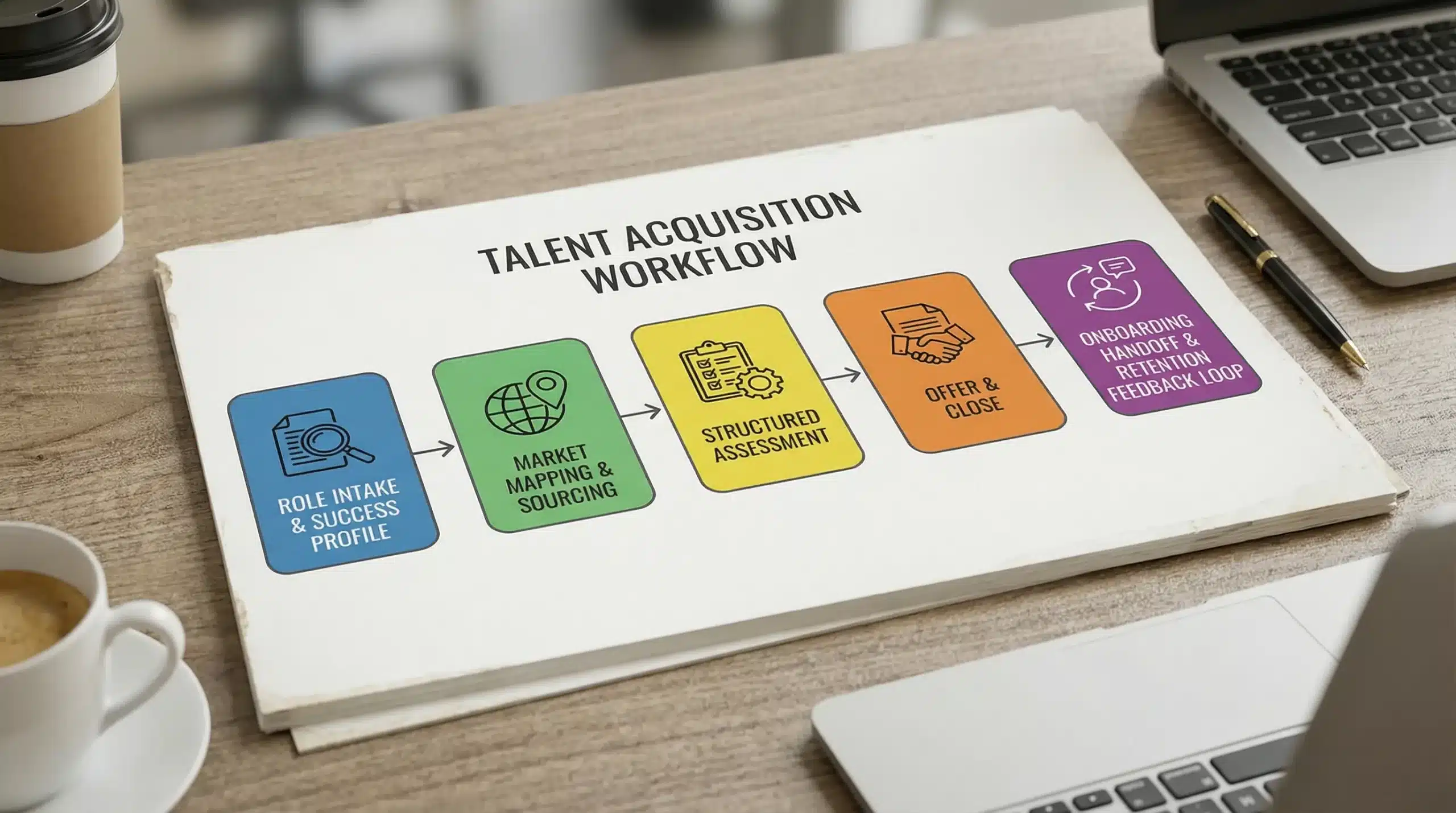
A talent acquisition specialist typically owns hiring outcomes across a function, business unit, or geography. The scope varies by company size, but the core is consistent: build a repeatable system for attracting, assessing, and closing the right talent.
In practice, the role sits at the intersection of HR, operations, and leadership. A strong TA specialist:
- Converts a “job description” into a success profile (what success looks like in 6 to 18 months).
- Builds and manages a pipeline (active and passive candidates).
- Runs structured assessment and decision support, not just resume screens.
- Advises hiring managers on market reality (comp, availability, relocation, competing offers).
- Protects candidate experience, compliance, and employer brand.
A contingency-style recruiter can be valuable for speed, but the TA specialist’s value is usually measured by quality, predictability, and continuous improvement, not just time-to-fill.
The must-have skills of a modern talent acquisition specialist
1) Role intake and calibration (turning “need someone strong” into a measurable profile)
Most hiring problems start with an unclear target. A TA specialist needs consultative skill to extract:
- Business outcomes (deliverables, revenue impact, risk exposure)
- Non-negotiables (licenses, technical scope, safety responsibilities)
- Leadership behaviors that fit the team (decision style, stakeholder management)
- Deal breakers (travel, onsite expectations, project types)
In engineering, this often means translating fuzzy requests like “a PM who can run big DOT jobs” into specifics such as project size, delivery model, claims exposure, schedule compression experience, and owner interface maturity.
2) Market mapping and sourcing strategy
Sourcing is not a single channel. It is a portfolio decision.
A TA specialist should be able to explain, upfront:
- Where the target talent actually sits (competitor firms, adjacent industries, public sector)
- Which profiles are realistic locally vs nationwide
- Whether you are competing on compensation, scope, flexibility, or brand
- How long it will take to generate a qualified shortlist
This is also where your TA specialist earns credibility with leaders by showing the tradeoffs clearly instead of overpromising.
3) Candidate engagement and closing (selling without overselling)
Top candidates rarely move for “a job.” They move for a better story: scope, autonomy, team, stability, leadership, and trajectory.
Great TA specialists treat the process like a two-way evaluation and manage four common friction points:
- Speed (slow decisions lose candidates)
- Clarity (vague roles create distrust)
- Consistency (mixed messages across interviewers)
- Confidence (candidates need proof the role is set up to succeed)
4) Structured assessment and evidence-based selection
If your assessment is unstructured, your hiring becomes a gut-feel contest.
High-performing TA specialists build structure into:
- Screening criteria tied to the success profile
- Interview scorecards (consistent questions per competency)
- Work samples when appropriate (case, portfolio review, project deep-dive)
- Reference checks that validate the specific risks of the role
This is also where psychometrics and behavioral assessment can add signal, especially for leadership roles where misalignment causes expensive churn.
5) Process governance and stakeholder management
Talent acquisition is a multi-stakeholder project. The TA specialist needs the operational discipline to define:
- Interview stages and decision makers
- Feedback SLAs (for example, feedback within 24 to 48 hours)
- Debrief process (how conflicts are resolved)
- Offer approval workflow (to prevent late-stage surprises)
Without governance, “we’re hiring” turns into “we’re talking,” and the best candidates exit.
6) Data literacy (measuring what matters)
TA specialists do not need to be data scientists, but they must be able to:
- Track funnel conversion rates
- Diagnose bottlenecks (screen-to-interview, interview-to-offer)
- Separate volume from quality
- Tie hiring outcomes to retention and performance signals
If your dashboards only show time-to-fill, you are likely missing the real story.
7) Compliance and risk awareness
In the U.S., TA work intersects with compliance, privacy, and fair hiring practices. A TA specialist should understand the basics of EEOC-aligned, consistent selection processes and avoid “informal” assessment steps that introduce bias or legal risk. The U.S. Equal Employment Opportunity Commission is a useful reference point for hiring leaders who want to align process with compliant practice.
Tools a talent acquisition specialist uses (and how to choose them)
Tools should reduce manual work, increase consistency, and improve decision quality. They should not create noise or vanity metrics.
Core tool categories
ATS (Applicant Tracking System): Your system of record for requisitions, stages, and compliance artifacts.
CRM (Candidate Relationship Management): Where you build and nurture pipelines, especially for passive talent.
Sourcing tools: Resume databases, talent insights, boolean search tooling, and platforms where your target talent actually spends time.
Assessment tools: Structured scorecards, technical evaluation workflows, and psychometric assessments when validated and used responsibly.
Scheduling and candidate experience tools: Self-scheduling, interview coordination, automated reminders, and clear communication templates.
Analytics and reporting: Funnel analytics, source quality, stage aging, and quality-of-hire proxies.
Automation and outbound engagement (use with care)
Automation can be useful when it improves speed and responsiveness without degrading trust.
For example, some teams use AI tools to accelerate outbound prospecting and fast follow-up for inbound interest on social channels. If Instagram is a meaningful acquisition channel for your niche (agency recruiting, staffing, or employer brand campaigns), a tool like Orsay positions itself as an AI-driven system for prospecting and responding to leads quickly, with automated qualification and appointment booking.
The key is governance: clear messaging standards, human review for high-stakes interactions, and strict respect for privacy and platform rules.
A simple “fit” checklist for TA tech
Before adding tools, a TA specialist should be able to answer:
- What process step is failing today (speed, quality, coordination, visibility)?
- What metric should improve if the tool works?
- Who owns adoption, training, and ongoing configuration?
- What is the failure mode (spammy outreach, bad data, duplicate workflows)?
If you cannot answer these, the tool likely becomes shelfware.
KPIs for a talent acquisition specialist (and what “good” looks like)
A TA specialist’s KPIs should reflect the business goal: predictable hiring outcomes with manageable risk.
That usually requires balancing efficiency, quality, and experience.
KPI cheat sheet
| KPI | What it measures | Why it matters | Common pitfall |
|---|---|---|---|
| Time-to-fill | Days from open req to accepted offer | Capacity planning and delivery risk | Optimizing speed at the expense of fit |
| Time-to-hire | Days from candidate application/sourcing to acceptance | Recruiting process speed | Ignores role intake delays and approvals |
| Slate quality | % of presented candidates who meet the success profile | Target accuracy | Defining “qualified” too loosely |
| Funnel conversion rates | Stage-to-stage movement (screen to interview, interview to offer) | Where process breaks down | Chasing volume instead of fixing bottlenecks |
| Offer acceptance rate | % of offers accepted | Comp competitiveness and process quality | Blaming compensation when process is slow or unclear |
| Quality of hire (proxy) | 90 to 180 day performance signals, hiring manager satisfaction, early retention | Real business impact | Using vague surveys with no objective anchors |
| 12-month retention | % of hires still employed after 12 months | Stability, cost control | Treating retention as “HR’s problem” only |
| Candidate NPS / experience | Candidate perception of fairness and clarity | Employer brand, re-applicants, referrals | Measuring only applicants, not finalists who decline |
| Hiring manager satisfaction | Hiring manager confidence in process and outcomes | Partnership strength | “Feel-good” scores not tied to outcomes |
| Source quality | Hires and performance by channel | Budget allocation | Rewarding the loudest channel, not the best |
KPIs that matter more in civil engineering and infrastructure
If you hire for project delivery environments, consider adding two operationally grounded metrics:
- Time-to-productivity (role-specific): How long until the hire can run key meetings, manage a schedule, own a budget line, or stamp deliverables (as applicable).
- Regretted attrition: Who leaves that you would fight to keep, and why.
These KPIs connect hiring to delivery risk, not just HR reporting.
Building a KPI dashboard that avoids vanity metrics
A useful TA dashboard does three things:
It connects to business outcomes
Time-to-fill matters, but only because delays affect utilization, bid capacity, project schedules, and leadership bandwidth. Tie recruiting metrics to operational consequences so leaders treat the dashboard as a decision tool.
If you want a parallel framework for quantifying downside, you can also model the cost of a bad hire. Alexander Executive Search publishes resources on this topic, including a practical Bad Hire Calculator to estimate how quickly hiring mistakes compound into six-figure losses.
It separates controllable vs uncontrollable factors
A TA specialist can improve:
- Process speed and stakeholder response times
- Screening accuracy
- Candidate experience
- Offer clarity and closing discipline
They cannot fully control:
- Market supply
- Competitor counteroffers
- Sudden budget freezes
Good reporting makes that distinction explicit, so TA is not punished for market reality.
It drives weekly action
If reporting does not change behavior, it is not a KPI system.
A practical weekly review can include:
- Reqs aging past a defined threshold
- Stages with low conversion (and why)
- Offers at risk (and next actions)
- Upcoming hiring manager interviews and decision deadlines
How to evaluate a talent acquisition specialist (interview scorecard for hiring leaders)
Whether you are hiring an in-house TA specialist or choosing a recruiting partner, ask for evidence of process.
Ask for artifacts, not opinions
Useful artifacts include:
- A sample intake template that converts business needs into a success profile
- A sample sourcing plan with target segments and outreach messaging
- A structured interview scorecard for one role type
- A dashboard showing funnel conversions and bottlenecks
Questions that reveal real capability
Instead of “How do you source?” ask:
- “Walk me through how you calibrate a role when the hiring manager is unclear.”
- “What are your top three leading indicators that a search will fail?”
- “How do you prevent slow decision-making from killing offer acceptance?”
- “Show me a time you changed the process based on data, what moved?”
The best TA specialists will answer with specific examples and measurable outcomes.
When to bring in a specialist recruiting partner
A strong internal TA function is ideal, but certain searches benefit from a specialist partner, particularly in tight markets.
Consider external support when:
- The role is senior, confidential, or business-critical
- You need access to passive talent across multiple states
- The market is thin and you cannot afford a trial-and-error process
- You need deeper assessment to reduce mis-hire risk
For civil engineering, infrastructure, and adjacent sectors, this is where a specialist executive search model and structured assessment process can materially reduce risk. If you are comparing approaches, AES outlines how an evidence-led methodology works in their overview of data-driven executive recruitment and shares practical guidance on improving hiring velocity without lowering the bar in recruiting solutions that cut time-to-hire in civil engineering.

Frequently Asked Questions
What is a talent acquisition specialist? A talent acquisition specialist manages the end-to-end hiring process, from role intake and sourcing strategy to assessment, offer closing, and reporting. The focus is on repeatable hiring outcomes, not just filling requisitions.
What skills are most important for a talent acquisition specialist in 2026? The most important skills are role calibration, market mapping, candidate engagement, structured assessment, stakeholder management, and data literacy. Compliance awareness and candidate experience discipline also matter.
What tools does a talent acquisition specialist use? Common tools include an ATS, a candidate CRM, sourcing platforms, assessment tools, scheduling software, and analytics dashboards. Some teams also use automation for outbound and inbound engagement, with clear governance.
What are the best KPIs for a talent acquisition specialist? The most useful KPIs balance efficiency (time-to-fill), quality (slate quality, quality of hire proxies, 12-month retention), and experience (candidate experience, offer acceptance rate). Funnel conversion rates help diagnose process bottlenecks.
How do you measure quality of hire without waiting a full year? Use leading indicators such as 90 to 180 day performance checkpoints, hiring manager satisfaction tied to specific success criteria, time-to-productivity, and early retention. Then validate against 12-month retention over time.
Need senior civil engineering talent, without the guesswork?
If hiring outcomes are becoming a delivery risk, a specialist recruitment partner can help you move faster while improving quality and retention. Alexander Executive Search supports U.S. civil engineering, infrastructure, engineering, and energy firms with an assessment-led search process, including RoleDNA-style role mapping, psychometric assessment capability, and a track record of high retention (AES reports 96% retention at 12 months).
To discuss a critical hire, pipeline strategy, or a more measurable recruiting process, explore Alexander Executive Search and request a confidential conversation.
OUR BLOG
Explore our latest articles
CONTACT US
Change starts with a conversation
Complete the form to get started. We’ll get in touch to discuss our services and your options with you ASAP.