
Hiring a senior leader in civil engineering is not a typical “fill the vacancy” exercise. One mis-hire can ripple into project delays, client churn, safety exposure, and a leadership vacuum that your existing principals have to absorb.
That’s why many presidents and business leaders turn to an executive job agency when the role is delivery-critical, confidential, or simply too hard to fill through inbound applicants.
This guide explains what to expect from the process, what you should receive at each stage, what you will be asked to do, and how to spot the difference between true executive search and simple resume forwarding.
What an executive job agency is (and isn’t)
An executive job agency (also called an executive recruiting agency or executive search partner) is a firm that runs a managed hiring process for senior roles, typically by:
- Defining the role as outcomes and risk, not just a job description
- Mapping the market to find qualified, often passive candidates
- Running structured screening and assessment
- Managing interviews, references, and closing
- Reducing hiring risk through process governance and (sometimes) guarantees
What it is not, at least not in a high-quality engagement, is a “CV shop” that simply posts your role, waits for applicants, and sends whatever looks close.
In civil engineering and infrastructure, the best agencies behave more like risk managers for leadership hires. They should be comfortable evaluating delivery evidence (projects, claims history, client relationships, safety record), and not just titles.
The executive job agency process, step by step
The exact terminology varies, but strong agencies follow a similar sequence. The key is to know what deliverables you should see, and what decisions you need to make.
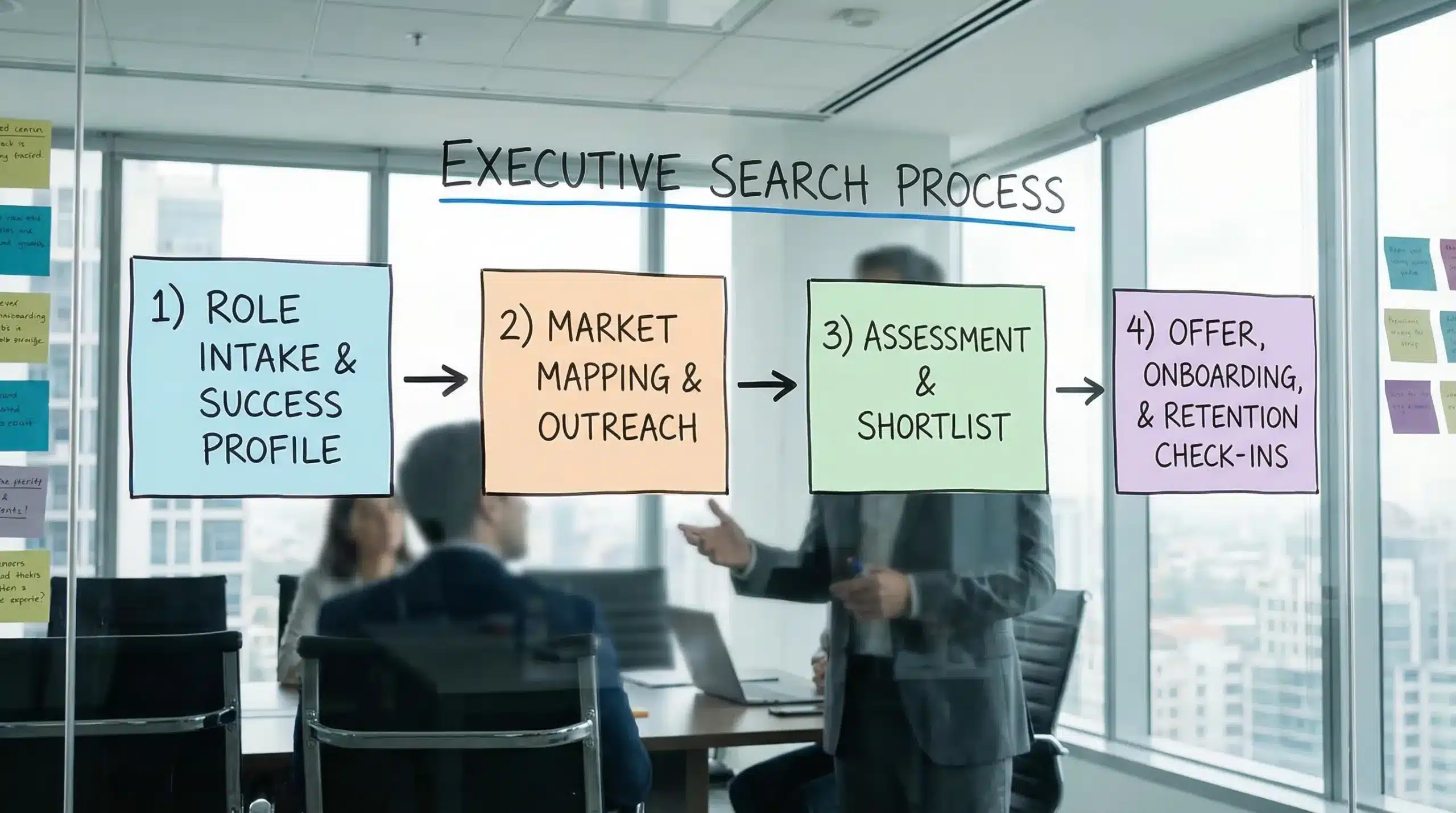
Phase 1: Kickoff, role intake, and success profile
Expect a structured intake. If the “brief” is just your existing job description, that’s a warning sign.
A robust intake should clarify:
- The business problem (why this hire exists now)
- Non-negotiables (licensure, client constraints, travel, security clearances)
- Success outcomes (what “great” looks like at 6 and 12 months)
- Team context (who they lead, who they influence, who they replace)
- Leadership behaviors required in your environment (pace, conflict, quality, safety, accountability)
In specialist search, this is often captured as a scorecard. Alexander Executive Search describes this role-definition approach as RoleDNA mapping, which is designed to align stakeholders on what the role truly requires before sourcing begins.
Phase 2: Market mapping and sourcing strategy
After intake, the agency should explain how they will actually find candidates.
In executive hiring, the best candidates are frequently not applying. Your agency should be prepared to:
- Build a target list (competitors, adjacent markets, specific geographies)
- Run confidential outreach that protects your brand
- Bring back market intelligence early (availability, compensation pressure, relocation friction)
If you are hiring in a tight niche (for example, a discipline lead with a specific DOT client history), a credible agency will tell you quickly whether your requirements are realistic, and what tradeoffs will unlock a faster, stronger shortlist.
Phase 3: Screening and evidence collection (beyond the resume)
This is where high-quality firms separate from the pack.
You should expect your agency to collect evidence that makes your interviews more decisive, such as:
- Verified project examples that match your delivery environment
- Clear scope, budget, and schedule accountability (not just “worked on”)
- Leadership scope (team size, cross-discipline coordination, subcontractor management)
- Reasons for moves and retention risk indicators
For engineering leadership, “evidence” also includes practical constraints like licensing and mobility. A good agency will surface these early to avoid late-stage surprises.
Phase 4: Assessment (structured, job-relevant, and consistent)
Assessment should match the risk of the hire.
Common elements in executive and senior engineering searches include:
- Structured interviews tied to the success profile
- Behavioral or psychometric assessment (used as decision input, not a decision by itself)
- Competency questionnaires or structured write-ups
- Deep reference checking (focused on outcomes and working style)
There is strong evidence in industrial-organizational research that structured methods outperform unstructured “gut feel” interviews. For example, the classic meta-analysis by Schmidt and Hunter (published in Psychological Bulletin) is often cited for showing higher predictive validity for structured approaches versus unstructured interviews.
If an agency claims to be assessment-led, ask what is standardized across candidates (questions, scoring, what “good” looks like), and what gets documented for your team.
Phase 5: Shortlist presentation and interview management
A true executive job agency should deliver a shortlist that is small, well-justified, and decision-ready.
Instead of a stack of resumes, expect candidate “packs” that help you compare people consistently. Depending on the agency, these might include structured summaries, assessment results, and role-fit commentary.
Also expect the agency to manage the logistics and the process discipline:
- Interview architecture (who meets whom, and in what order)
- Stakeholder alignment (so you do not re-litigate requirements every round)
- Feedback capture and calibration between interviewers
This is not administrative busywork. It’s how you prevent the two most common executive hiring failures: inconsistent evaluation and slow decisions.
Phase 6: References, risk checks, and final alignment
Quality agencies do not treat references as a box-check.
Expect references to probe:
- Delivery outcomes (how the candidate performed under pressure)
- Leadership behaviors (conflict, accountability, coaching, decision speed)
- Reliability signals (follow-through, stakeholder management, ethics)
For civil engineering leadership roles, you may also need role-specific diligence (licensure confirmation, conflicts, client restrictions). Your agency should help you define what is appropriate and lawful, and when to involve your counsel or compliance team.
Phase 7: Offer strategy, negotiation, and closing
This is where many “good searches” fall apart.
A strong executive job agency helps you reduce offer risk by:
- Pre-closing candidates before the final interview (so compensation and constraints are surfaced early)
- Managing counteroffer risk and resignation timing
n- Aligning stakeholders on must-haves versus nice-to-haves
If you want a deeper look at how this stage should be run, AES has a dedicated guide on offer and onboarding mechanics: Executive Placement Agency: How Offers and Onboarding Are Managed.
Phase 8: Onboarding support and retention follow-through
The process should not end when the offer is signed.
For leadership roles, a practical agency will encourage a structured 30/60/90 plan and early check-ins. The goal is to reduce “regretted attrition” caused by role ambiguity, misaligned expectations, or early political friction.
Some specialist firms also back their work with a guarantee. For example, Alexander Executive Search highlights a 12-month replacement guarantee for certain senior hires, designed to transfer part of the hiring risk away from the client. (Always confirm the exact terms in the agreement.)
What you should receive at each stage (client deliverables)
Use this table as a quick expectation-setter with any executive job agency.
| Stage | What a strong agency does | What you should receive | What you must provide |
|---|---|---|---|
| Intake and role definition | Runs stakeholder intake and defines success outcomes | Success profile or scorecard, hiring plan, timeline | Clear decision owner, interview panel, compensation guardrails |
| Market mapping and outreach | Builds target market list and executes outreach | Market feedback, pipeline visibility, early risk flags | Fast feedback on must-have tradeoffs |
| Screening and assessment | Collects evidence consistently across candidates | Decision-ready candidate summaries, assessment outputs where used | Availability for interviews and timely decisions |
| Shortlist and interviews | Designs interview architecture and calibrates feedback | Shortlist rationale, interview schedule, consolidated feedback | Consistent interviewers, scorecard discipline |
| References and closing | Validates final risks, manages negotiation | Reference themes, close plan, start-date strategy | Offer approval speed, onboarding sponsor |
Timelines: how long an executive job agency search takes
For leadership roles in civil engineering, it’s common for a well-run process to take several weeks to a few months from kickoff to accepted offer, depending on seniority, geography, confidentiality, and candidate availability.
The factors that most often extend timelines are predictable:
- Hard constraints (PE licensure, client approvals, security requirements)
- Relocation friction (family timing, cost of living, travel expectations)
- Stakeholder calendars (too many interviewers, too little availability)
- Late-stage misalignment (changing requirements midstream)
A good agency will not promise a timeline without first tightening the success profile, confirming your decision cadence, and testing the market.
If time-to-hire is a pressing concern, it helps to treat interviews and offer approval like a project schedule. AES shares practical process design ideas in Recruiting Solutions That Cut Time-to-Hire in Civil Engineering.
Fees and engagement models (what you are really paying for)
Executive job agencies typically work under one of two models:
Contingent recruiting: The agency is paid if they place someone. Because multiple firms can compete, incentives often push toward speed and “available candidates.” This can work for less critical roles, but it can underperform when you need passive talent, confidentiality, or deep assessment.
Retained (or exclusive) search: You pay to run a defined search process, usually with agreed milestones and deliverables. This model is more compatible with market mapping, structured assessment, and true project management.
For an engineering leadership hire, the cost conversation should never be only about the fee. It should be about the cost of vacancy and the cost of a mis-hire. If you want to quantify the risk, AES provides a Bad Hire Calculator that’s useful for building an internal business case.
To go deeper on how contracts, guarantees, and scope should be defined, see: Executive Staffing Agency Checklist: Contracts, Fees, Guarantees.
Your role as the client: how to make the process work
Even the best executive job agency cannot outrun internal ambiguity or slow decisions.
To get a strong shortlist faster, plan to provide:
- A single accountable decision owner (not a committee)
- A realistic compensation range and non-negotiables upfront
- Interview availability held on calendars in advance
- A consistent evaluation method (scorecard, structured questions)
- Fast feedback after each interview round (same day if possible)
When clients do this well, agencies can spend more time on what actually moves outcomes: sourcing the right market and validating evidence.
Red flags: when an “executive job agency” is really just forwarding resumes
If you want executive-level rigor, watch for these warning signs:
- They can’t describe their assessment method beyond “we interview them.”
- They avoid specificity on sourcing (no market map, no target list logic).
- They flood you with candidates instead of presenting a tight shortlist.
- They cannot explain how they manage confidentiality and off-limits conflicts.
- They don’t ask hard questions in intake (they accept a vague job description).
- They measure success only by speed, not retention or performance trajectory.
In civil engineering, those patterns tend to correlate with higher mis-hire risk, especially when the role controls project outcomes or client relationships.
What “good” looks like: metrics that matter after the hire
Time-to-fill matters, but it is not the business outcome. For leadership hiring, align with your agency on metrics that reflect real performance.
| Metric | Why it matters | How a good agency supports it |
|---|---|---|
| 12-month retention | Indicates role clarity and fit | Better intake, evidence-based assessment, closing discipline |
| Time-to-productivity | Protects delivery and client commitments | Clear success profile and onboarding plan |
| Offer acceptance rate | Signals candidate experience and close quality | Pre-close, market intelligence, aligned offer strategy |
| Regretted attrition | Shows whether exits were preventable | Early risk identification and expectation alignment |
AES publicly positions its process around retention, citing 96% retention after 12 months in multiple resources across its site. When you evaluate any executive job agency, ask for comparable retention definitions and how they’re calculated.
If you’re hiring an executive in civil engineering, set expectations early
The best results come when you treat the engagement as a governed search project with clear deliverables, timelines, and decision rights. That’s what protects your firm from the hidden cost of leadership turnover and missed delivery.
If you’re considering a specialist partner for a civil engineering or infrastructure leadership hire, you can explore AES’s approach to evidence-based hiring in How Alexander Executive Search Removes the Guesswork from Recruitment, or quantify mis-hire risk using their Bad Hire Calculator.
OUR BLOG
Explore our latest articles
CONTACT US
Change starts with a conversation
Complete the form to get started. We’ll get in touch to discuss our services and your options with you ASAP.